

The Human body that reveal just how complex, resilient, and utterly bizarre our physical forms
You Regrow an Entirely New Outer Skin Every MonthYour skin is the body’s largest organ, and it is constantly under construction. Every minute, you shed between 30,000 and 40,000 dead skin cells. Over the course of a single day, that adds up to around 50 million cells. This continuous sloughing means that your entire outer layer of skin (the epidermis) replaces itself roughly every 28 to 30 days.
In fact, a massive percentage of the dust that collects in ordinary households is actually made up of dead human skin cells! Your Blood Vessels Could Circle the Globe Twice If you were to unravel the entire circulatory system of a single adult—including all arteries, veins, and microscopic capillaries—and lay them out end-to-end, the total length would stretch for about 60,000 miles (nearly 100,000 kilometers). For children, that number is around 60,000 miles, and for adults, it can approach close to 100,000 miles. Because the Earth’s circumference is roughly 24,901 miles, your body’s plumbing network is long enough to wrap around the world nearly four times. Your heart pumps blood through this massive, intricate highway every single minute of your life.
The Human Brain Generates Enough Electricity to Power a Lightbulb The brain is a massive biological supercomputer powered entirely by electrochemical signals. When you are awake, your brain utilizes billions of neurons to send messages back and forth. This collective electrical activity generates about 20 watts of power.
While 20 watts doesn’t sound like much, it is more than enough to illuminate a low-wattage LED lightbulb. All your thoughts, dreams, and actions are fueled by a current of electricity running through your skull. We tend to think of ourselves as purely human, but from a cellular standpoint, you are actually a walking ecosystem. Scientists estimate that the average human body consists of roughly 30 trillion human cells.synthesize vitamins, and train your immune system. The human stomach is a highly hostile environment. To break down food and destroy harmful pathogens, the stomach secretes gastric juice, which primarily consists of hydrochloric acid (HCl). This acid is so potent that it typically sits between a 1.5 and 2.0
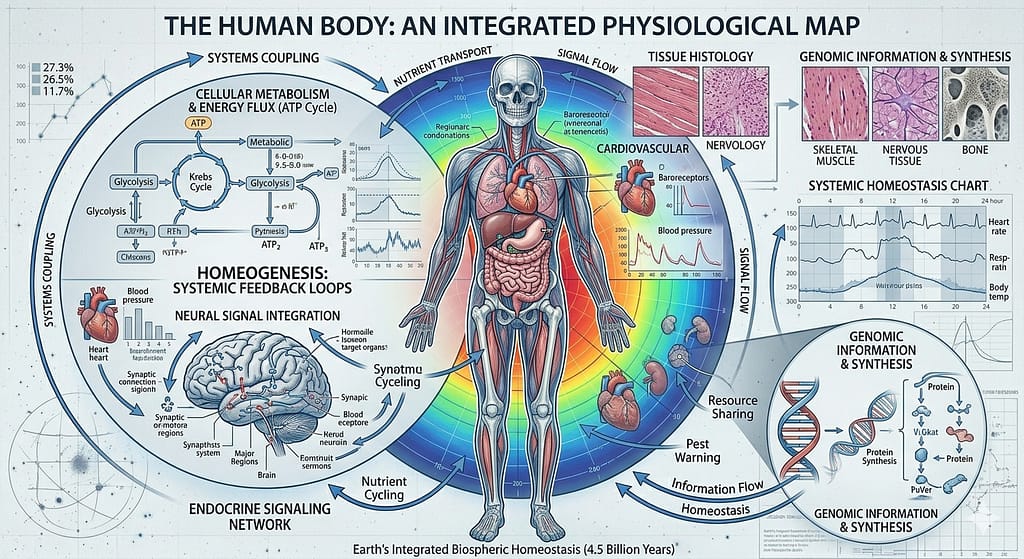
The Cellular Metropolis
To understand the scale of the human body, we must first look at its building blocks. The average adult body is composed of roughly 30 trillion human cells. However, we are not traveling through life alone. The body hosts a vast ecosystem known as the microbiome, containing an estimated 38 trillion bacterial cells, mostly residing in our gut. By sheer numbers, you are technically more microbe than you are human.
Within our human cells, the structural engineering is even more mind-boggling:
The DNA Blueprint: Every cell contains a tightly coiled strand of DNA. If you were to uncoil the DNA from just one of your cells, it would stretch about 6 feet long.
A Cosmic Length: If you uncoiled the DNA from every single cell in your body and placed them end-to-end, the strand would stretch over 60 billion miles. That is long enough to travel from Earth to Pluto and back, multiple times.
Constant Regeneration: Your body is a perpetual construction site. Every single second, your bone marrow produces roughly 2 to 3 million new red blood cells to replace old ones, ensuring your tissues never starve for oxygen.
The Unstoppable River: The Circulatory Highway
The transportation network responsible for keeping this cellular metropolis alive is the circulatory system. If you were to unravel all the arteries, veins, and microscopic capillaries from a single adult and lay them out in a straight line, the total distance would reach approximately 60,000 to 100,000 miles.
Because the circumference of the Earth is about 24,901 miles, your internal plumbing system is long enough to wrap around the globe nearly four times.
[ Your Body's Blood Vessels ] = 100,000 Miles [ Earth's Circumference ] = 24,901 Miles Result: Your blood vessels can wrap around the Earth 4 times!Driving this massive highway is the heart—a muscular pump no bigger than a clenched fist. The heart does not rest. Over an average lifetime, it will beat more than 2.5 billion times, pumping roughly 1 million barrels of blood. The pressure generated by a human heart is powerful enough to squirt blood a distance of 30 feet. This immense pressure is vital; it ensures that blood can travel from your chest all the way down to your toes and fight gravity to rush back up to your head in a matter of seconds.
The Biological Furnace: Extreme Chemistry
The chemical laboratory inside the human body is incredibly hostile yet beautifully contained. The primary example of this is the stomach. To break down solid food and kill dangerous pathogens, the stomach secretes gastric juices consisting largely of hydrochloric acid (HCl).
On the pH scale—where 7 is neutral and 0 is highly acidic—human stomach acid typically registers between 1.5 and 2.0. This makes it chemically strong enough to dissolve a steel razor blade or a piece of zinc within a few hours.
How does the body contain such a volatile liquid without destroying itself? The stomach employs a brilliant defensive strategy: it creates a thick, alkaline mucus barrier that lines its interior wall, neutralizing the acid before it can touch the tissue. Additionally, the stomach lining is highly dynamic, completely regenerating its inner cellular surface every three to five days to heal any minor acid burns before they turn into ulcers.
The Eye’s Super-Resolution
Your eyes are far more advanced than any camera ever manufactured. Scientists estimate that if the human eye were a digital camera, it would have a resolution of 576 megapixels. It can distinguish between roughly 10 million distinct colors. Our eyes are so sensitive to light that under perfectly dark, clear conditions—such as a dark night on a mountaintop—the human eye can detect a single photon of light, or notice a candle flickering from 30 miles away.
An Everyday Miracle
We often look to the stars, the deep oceans, or the cutting edge of technology to find wonders, forgetting that the ultimate marvel is staring back at us in the mirror. The human body is a self-healing, self-cleaning, constantly adapting ecosystem.
It is a machine that feels, thinks, creates art, and experiences love, all driven by a complex choreography of electricity, chemistry, and biological engineering. You are not just living in the universe; your body is a small, perfectly organized universe of its own.
The 20-Watt Supercomputer: The Nervous System
Perched at the top of our physical structure is the human brain, arguably the most complex structure in the known universe. Weighing just about 3 pounds, the brain contains roughly 86 billion neurons, each connected to thousands of others, creating trillions of synaptic pathways.
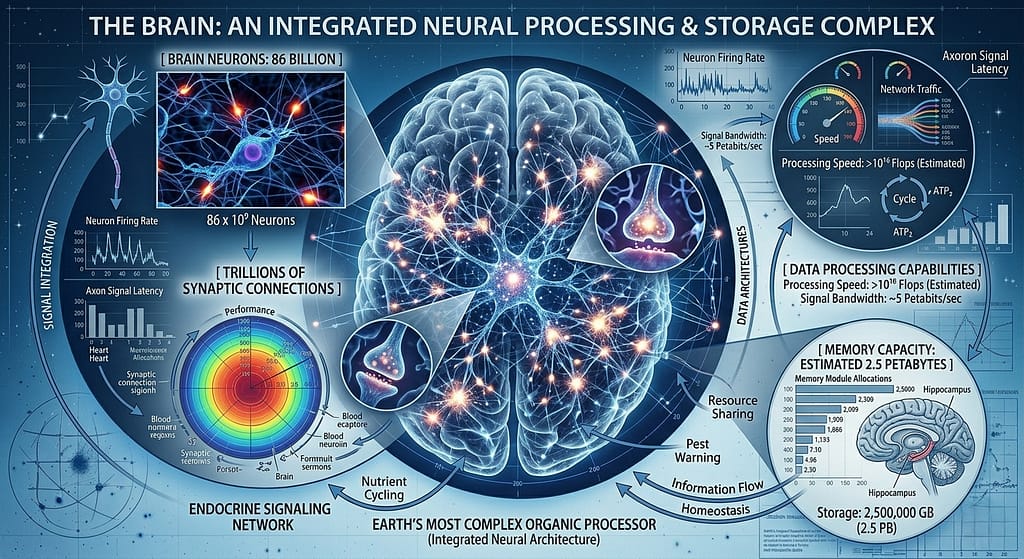
[ Brain Neurons: 86 Billion ]
(Trillions of Synaptic Connections)
[ Memory Capacity: Estimated 2.5 Petabytes (2,500,000 GB) ]
👉🏻Next post:Amazing Fact Earth

Leave a Reply