

The Soul in Earth” can be interpreted in two profound ways: literally, as the living, breathing biological network that animates the soil beneath our feet; and metaphorically, as the philosophical and ecological concept of Anima Mundi (the World Soul)—the idea that the Earth itself is a sentient, interconnected organism.
To explore the soul in Earth is to journey through ancient philosophy, advanced microbiology, and modern ecological science. Here is an exploration of that vital, hidden life force, detailed across its spiritual, biological, and ecological dimensions.
The Philosophical Soul: Anima Mundi and Gaia
For millennia, humans did not view the Earth as a dead rock floating in space, but as a living being.
JThe World Soul: In ancient Greek philosophy, Plato introduced the concept of the Anima Mundi—the World Soul. In his dialogue Timaeus, he described the universe as a “living creature endowed with soul and reason.” This perspective argues that just as a human body is animated by a soul, the Earth possesses a collective spiritual essence that connects all living things.
The Biological Soul: The Living Soil
If the planet has a physical location for its soul, it is not deep in the molten core, but in the thin, fragile layer of topsoil covering the land. The words “humus” (soil) and human share the same linguistic root—we are intrinsically tied to the earth. Soil is not dirt; dirt is dead. Soil is spectacularly, densely alive. A single teaspoon of healthy soil contains more living organisms than there are people on planet Earth. This subterranean matrix is the literal life force of the terrestrial world. The Microbial Symphony: The soul of the soil is composed of billions of microorganisms working in absolute synchronization Tiny decomposers that break down organic matter, turning dead leaves and wood into vital nutrients like nitrogen and phosphorus that plants can absorb. Protozoa and Nematodes: Microscopic hunters that consume bacteria, releasing locked-up nutrients back into the ecosystem. Earthworms The “intestines of the earth,” as Aristotle called them. They tunnel through the earth, aerating the soil, allowing oxygen and water to reach plant roots, and creating rich castings that act as premium fertilizer.

Without this microscopic workforce, global nutrient cycles would grind to a halt. The Earth would become a sterile wasteland, proving that this biological layer is indeed the animating spark—the soul—of our landscapes.
The Mycelial Network: Earth’s Internet Perhaps the most stunning manifestation of a literal “soul” or collective consciousness in the Earth is the Mycorrhizal Network, often referred to by biologists as the “Wood Wide Web.”
The Fungal Thread Beneath the forest floor lies a vast, web-like network of fungal threads called mycelium. These threads thread themselves into the roots of trees and plants, creating a symbiotic relationship.
[ Tree A ] <—- (Mycorrhizal/Mycelial Network) —-> [ Tree B ]
( Nourishes) (Warns of Pests)
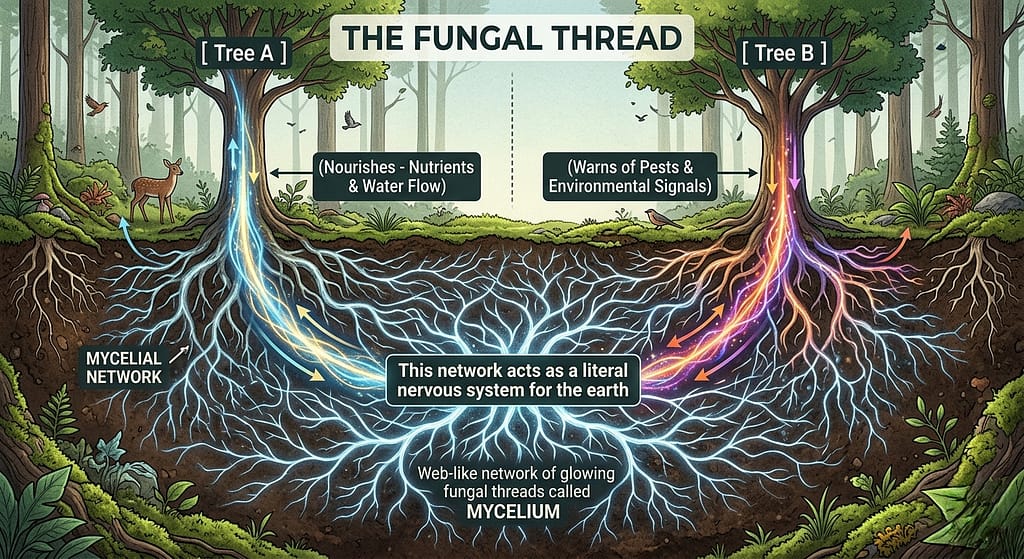
Network acts as a literal nervous system earth
Resource Sharing: If a mature tree has access to abundant sunlight, it can pump sugars through the fungal network to nourish a struggling sapling growing in the shade. The Planetary Defense System: When a plant is attacked by pests, it sends chemical warning signals through the mycelium to neighboring plants. Upon receiving the signal, the neighboring plants immediately begin producing defensive toxins to ward off the impending insect attack.
Memory and Communication: This network remembers pathways, stores resources, and manages the health of the entire forest community, acting remarkably like a decentralized brain.
The Chemistry of Connection: Geosmin and Microbial Joy
The human connection to the Earth’s soul is hardwired into our biochemistry. There is a distinct, universally loved scent that rises from the ground after the first rain following a dry spell. This scent is called petrichor.
The primary compound responsible for this smell is geosmin, a chemical produced by soil-dwelling bacteria called Actinomycetes. Humans are incredibly sensitive to geosmin; our noses can detect it at a concentration of just five parts per trillion. Evolutionarily, this scent signaled the arrival of life-giving water and fertile lands.
Furthermore, a specific soil bacterium called Mycobacterium vaccae has been found to trigger the release of serotonin in the human brain—the neurotranscript responsible for feelings of happiness and relaxation. When we garden, walk barefoot, or handle soil, we physically absorb these micro-elements. The Earth’s soil quite literally soothes the human spirit, showing a direct chemical bridge between the soul of the earth and our own.
Threat to the Soul: Degraded Earth
The soul of the earth is resilient, but it is currently under severe duress. Industrial agriculture, deforestation, chemical pollution, and urbanization are stripping the earth of its living skin.
When soil is repeatedly sprayed with synthetic pesticides and fertilizers, the delicate microbial ecosystems and mycelial webs are destroyed. The soil loses its structure, turns to dust, and is washed away by rain or blown away by the wind—a process known as desertification.
Losing the living elements of our soil means losing the planet’s ability to grow food, filter water, and capture carbon dioxide. Protecting the “soul in earth” is no longer just a poetic sentiment; it is a critical requirement for human survival. Regenerative agriculture, reforestation, and conservation efforts are ways we can help heal this living network.
Tuning into the Earth
The soul in earth is not a singular, ghostly phantom hidden in the planet’s core. It is a brilliant, decentralized, highly collaborative tapestry of life. It is found in:
The balanced chemistry of the global atmosphere (Gaia).
The millions of microbes generating nutrients in a handful of mud (The Soil).
The underground fungal webs connecting ancient forests (The Mycelium).
The emotional and chemical peace humans find when connecting with nature (Petrichor).
To find the soul in Earth, one only needs to look down, step outside, and recognize that the ground beneath us is not a passive stage we walk upon, but a living partner that sustains every breath we take.
👉🏻Also Read: Science & Human Body👈🏻


Leave a Reply