

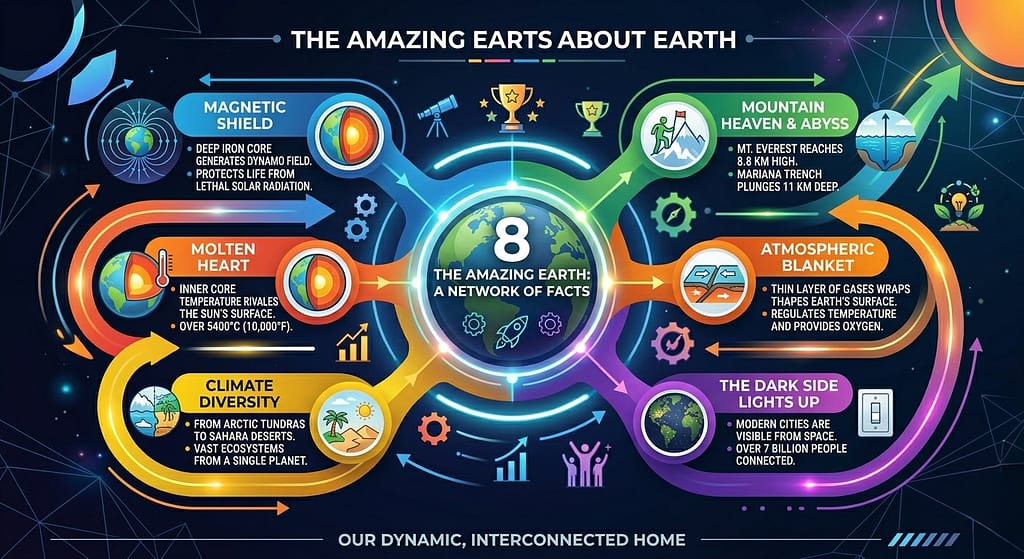
Deep inside Earth, the spinning liquid iron outer core acts like a massive electromagnet. This generates a powerful magnetic field that wraps around the planet, shielding us from destroying solar winds and cosmic radiation.
We Are Moving at Incredible Speeds: Right now, you feel like you are sitting still, but you are actually hurtling through space. Earth rotates on its axis at roughly 1,600 km/h (1,000 mph) at the equator, while simultaneously orbiting the Sun at a blistering 107,000 km/h (66,600 mph).
Most of Earth is Completely Pitch Black: Oceans cover about 71% of the Earth’s surface. Because sunlight cannot penetrate deeper than about 200 meters (656 feet) into the ocean, the vast majority of our planet’s water exists in permanent, absolute darkness.
It Has a “Living” Skin: As you saw with the mycelial network, the Earth’s crust isn’t just dead rock. It is covered in a microscopic and fungal grid that allows plants to communicate, and it features massive tectonic plates that constantly shift, recycling carbon and keeping the planet habitable.
The Core is as Hot as the Sun: The temperature of Earth’s solid iron inner core is estimated to be around 5,200°C to 6,000°C (9,392°F to 10,832°F). That is roughly the exact same temperature as the surface of the Sun.
Earth is the Only Planet Not Named After a God: All the other seven planets in our solar system are named after Roman gods or goddesses (like Mars, Venus, and Jupiter). The word “Earth” simply comes from old Germanic and English words (‘Ertha’ or ‘Eorde’), which mean “the ground.”
The Living Canvas: Understanding Earth’s Dynamic Balance
For thousands of years, humanity looked at the horizon not as a collection of resources, but as a living, breathing entity. Across ancient cultures, this intuition was given names like Anima Mundi (the World Soul) or Gaia. While modern science eventually traded mythological prose for tectonic and atmospheric equations, the deeper reality remains unchanged: Earth behaves far more like a singular, self-regulating biological organism than a dead rock tumbling through the void of space.
When we look at Earth’s complex systems, we see a planetary body built entirely on deep interconnectedness. Consider the ground beneath our feet. Far from being a static mass of dirt, the Earth’s crust is a bustling network of geological and biological activity. Tectonic plates shift seamlessly over the mantle, recycling carbon and essential minerals back into the atmosphere and oceans, acting like a global respiratory system. Simultaneously, just millimeters below the forest floor, vast mycorrhizal networks—the “fungal threads” of mycelium—connect diverse plant species. This subterranean grid acts as a planetary nervous system, passing nutrients to starving saplings and sending biochemical warning signals to neighboring trees when pests attack. Life does not simply exist on Earth; life actively shapes Earth.
This continuous dialogue between the living biosphere and the physical environment is what allows our planet to maintain a delicate, miraculous equilibrium known as homeostasis. The Earth naturally self-regulates its temperature, ocean salinity, and atmospheric composition. If the surface grows too warm, feedback loops trigger increased cloud cover to reflect sunlight. If carbon dioxide spikes, marine organisms and dense rainforests accelerate their consumption to cool the planet back down. It is a massive, automated life-support system operating at a planetary scale.
Earth’s Dynamic Balance
Yet, this balance exists within a hostile cosmic arena. Earth is perpetually hurtling through a chaotic solar system, rotating at 1,600 km/h while orbiting the Sun at an astonishing 107,000 km/h. To survive this high-speed journey, the planet generates its own protective armor. Deep in the outer core, churning rivers of liquid iron create a massive electromagnetic shield. This magnetosphere deflects deadly cosmic radiation and solar winds that would otherwise strip away our atmosphere and boil our oceans into space.
Ultimately, Earth is a profound paradox. It is incredibly robust, having survived asteroid impacts, ice ages, and mass extinctions over its 4.5-billion-year history, constantly reinventing itself. Yet, it is also beautifully fragile—a lone, vibrant oasis of liquid water and breathable air surrounded by the absolute pitch-black vacuum of space. To study Earth is to realize that we are not separate observers looking down at a planet; we are an extension of it. Every breath of oxygen we take connects our lungs to the ancient global rhythm that sustains this living world…
👉🏻Next Post:Rank Math SEO👈🏻


Leave a Reply