

This is why trading psychology is an essential part of becoming a successful trader. Learning how to manage emotions can help traders make decisions based on their trading plan instead of reacting emotionally to every price movement.
In this guide, we will explore how emotions affect trading decisions, the most common psychological mistakes traders make, and practical ways to develop better trading discipline.
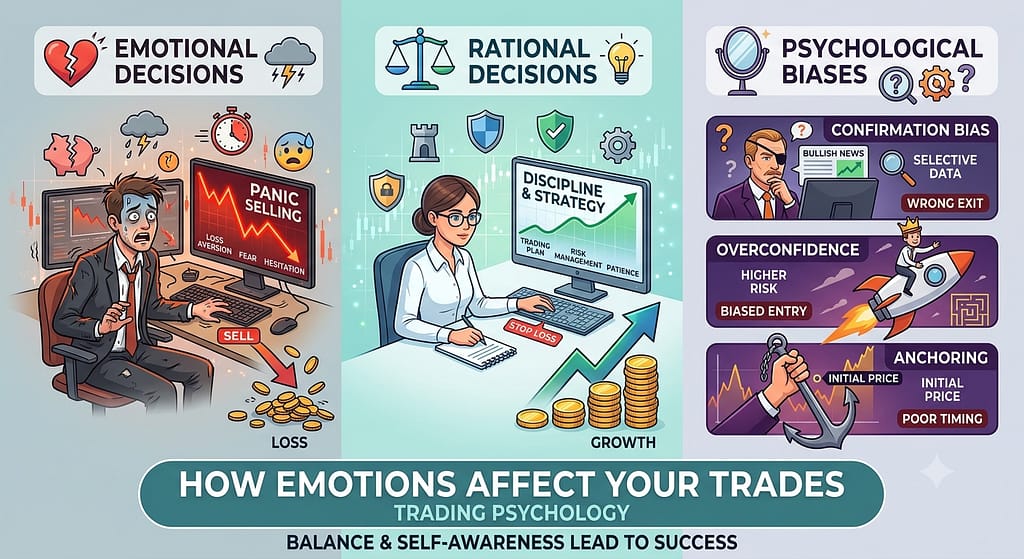
What Is Trading Psychology?
Trading psychology refers to the emotional and mental state that influences a trader’s decisions.
When you enter a trade, you are not simply looking at numbers on a screen. Your brain is also reacting to the possibility of gaining or losing money. A small price movement can make you feel excited, nervous, confident, or worried.
For example, imagine buying a stock at $100. If it rises to $105, you may feel confident and want to hold it longer. If it suddenly falls to $97, you might become nervous and sell even though your original analysis has not changed.
This emotional reaction can cause traders to make decisions that do not follow their original plan.
Good trading psychology does not mean having no emotions. That is unrealistic. Instead, it means recognizing your emotions without allowing them to control your decisions.
Why Psychology Matters in Trading
Markets are unpredictable. Even the best analysis cannot guarantee that every trade will be profitable.
A trader may experience several winning trades and then face a losing trade. The way they respond can determine what happens next.
A disciplined trader might accept the loss and continue following their plan.
An emotional trader might try to immediately recover the money by taking a much larger or riskier trade.
That second behavior can lead to even bigger losses.
Trading psychology matters because financial markets create situations where human emotions naturally become stronger. You may see a stock rising quickly and feel that you are missing an opportunity. You may watch your position fall and become afraid of losing more money.
The challenge is learning to respond rationally rather than impulsively.
The Most Common Emotions in Trading
Several emotions appear repeatedly in the trading process. Understanding them is the first step toward controlling them.
1. Fear
Fear is one of the strongest emotions in trading.
It can appear before entering a trade, while holding a losing position, or after experiencing several losses.
For example, a trader may analyze a stock and decide to buy it at $50. But when the price drops to $48, fear takes over. The trader sells immediately because they are afraid that the price will continue falling.
If the trade was supposed to remain open until a predetermined stop-loss level, selling early because of fear means abandoning the original strategy.
Fear can also cause traders to avoid good opportunities after experiencing losses.
The solution is not to eliminate fear completely. Instead, traders should use proper risk management so that a single trade does not create overwhelming emotional pressure.
2. Greed
Greed is another major problem.
After making a profit, traders may start believing that the market will continue moving in their favor forever.
Suppose a trader buys a stock at $100 and it rises to $120. Instead of following the original profit target, the trader becomes greedy and decides to hold indefinitely.
The stock later falls to $108.
The trader may eventually sell with a much smaller profit—or even wait so long that the trade becomes a loss.
Greed can also encourage traders to use excessive leverage or put too much money into one position.
A good trading plan should define how much risk is acceptable before the trade is entered.
3. FOMO: Fear of Missing Out
FOMO happens when traders see an asset moving quickly and feel they must enter immediately.
Imagine a stock suddenly jumps 15% in a short period. Social media is full of people talking about it. A trader who was not planning to buy the stock may suddenly enter because they are afraid of missing the opportunity.
This is dangerous because the price may already have moved significantly.
Instead of entering because of excitement, traders should ask:
- Was this trade part of my strategy?
- Did I wait for my planned entry?
- What is my risk?
- Where is my stop-loss?
- Is the potential reward worth the risk?
If the answers are unclear, entering the trade simply because everyone else is buying may not be a disciplined decision.
4. Overconfidence
Winning can create another psychological problem: overconfidence.
After several successful trades, a trader may start believing they have mastered the market.
They may increase their position size, ignore risk management, or stop following their trading plan.
Unfortunately, markets can quickly remind traders that previous success does not guarantee future results.
A successful trader understands that losses are always possible.
Confidence is useful, but overconfidence can become dangerous when it removes discipline.
5. Revenge Trading
Revenge trading occurs when a trader tries to recover losses quickly by taking additional trades.
For example, imagine losing $200 on a trade. Instead of accepting the loss, the trader immediately enters another position with a larger amount, hoping to make the $200 back.
If that trade also loses money, frustration can increase.
The trader may continue taking bigger positions.
This can create a destructive cycle:
Loss → Anger → Larger Trade → Bigger Loss → More Frustration → Even Larger Trade
The best response to a significant emotional loss is often to step away from the market and review what happened.
How Emotions Can Affect Trading Decisions
Emotions can influence almost every stage of a trade.
Before Entering a Trade
Excitement or FOMO may cause traders to enter too early.
Fear may prevent them from entering a trade that actually meets their strategy.
During a Trade
Fear can cause premature exits.
Greed can cause traders to ignore profit targets.
Hope can cause traders to hold losing positions for too long.
After a Trade
A winning trade can create overconfidence.
A losing trade can create frustration or revenge trading.
This shows why trading psychology is not only about controlling emotions while a position is open. It is a continuous process.
The Importance of a Trading Plan
One of the best ways to reduce emotional decision-making is to create a clear trading plan.
A trading plan should define:
- What markets or assets you trade
- What setups you look for
- Your entry conditions
- Your stop-loss rules
- Your profit-taking strategy
- How much you are willing to risk
- When you will stop trading for the day
- How you will review your trades
The purpose of a trading plan is to create structure.
Instead of asking yourself what to do every time the market moves, you already have rules to follow.
This can reduce impulsive decisions.
Risk Management Helps Control Fear
Risk management is closely connected to psychology.
If you risk too much money on a single trade, even a small price movement can create intense fear.
For example, risking 1% of your trading account may feel emotionally manageable for many traders, while risking a large portion of the account can create enormous pressure.
There is no universal risk percentage that is right for everyone, but the key principle is simple:
Do not risk so much on one trade that normal market movements cause you to panic.
Before entering a trade, know how much you could lose if your analysis is wrong.
Never assume that every trade will be profitable.
Learn to Accept Losses
Losses are part of trading.
Even experienced traders can have losing trades.
A losing trade does not automatically mean that you are a bad trader. What matters is whether the trade followed your strategy and whether the risk was controlled.
Think about trading as a series of decisions rather than one individual outcome.
You might have a strategy that produces profitable results over many trades while still experiencing individual losses.
The goal is not to win every trade.
The goal is to execute a strategy consistently while managing risk.
Do Not Let One Trade Define You
One of the biggest psychological mistakes is becoming emotionally attached to a trade.
A trader might think:
“I have already lost so much, so I cannot sell now.”
This is a dangerous mindset.
The amount already lost should not determine what you do next. Instead, ask whether the position still meets your trading rules.
If the original reason for entering the trade is no longer valid, holding simply because you do not want to accept a loss can make the situation worse.
Keep a Trading Journal
A trading journal is one of the most useful tools for improving trading psychology.
After each trade, record information such as:
- Entry price
- Exit price
- Position size
- Reason for entering
- Stop-loss level
- Profit target
- Result
- Emotional state
- Whether you followed your plan
After several weeks or months, review your journal.
You may discover patterns.
Perhaps you enter trades too quickly after seeing large price movements. Maybe you move stop-losses when trades go against you. Or perhaps you take unnecessary trades after losing money.
Recognizing these patterns gives you an opportunity to improve.
Use a Pre-Trade Checklist.
A simple checklist can prevent emotional trades.
Before entering a position, ask:
- Does this trade meet my strategy?
- Why am I entering?
- Where is my stop-loss?
- Where is my planned exit?
- How much am I risking?
- Am I entering because of analysis or emotion?
- Would I still take this trade if nobody else was talking about it?
If you cannot answer these questions clearly, consider waiting.
Sometimes the best trading decision is not trading.
Avoid Constantly Watching the Market
Watching every price movement can increase emotional pressure.
If you constantly monitor a position, every small movement may feel important.
A stock moves slightly lower and you become worried.
It rises slightly and you become excited.
This can lead to unnecessary decisions.
Depending on your trading strategy, consider using predetermined alerts, stop-loss orders, and planned exits rather than reacting to every small movement.
Develop Patience
Successful trading requires patience.
Not every day offers a good opportunity.
Sometimes the market is moving sideways. Sometimes your preferred setup does not appear.
An impatient trader may create trades simply because they feel they need to trade.
This is called overtrading.
Remember:
You do not need to trade every day to be a trader.
Waiting for a high-quality setup can be a sign of discipline, not inactivity.
Focus on the Process, Not Just Profit
Many beginners measure success only by how much money they make.
But profit alone does not tell the whole story.
Suppose you make $500 from a trade that involved taking far more risk than your plan allowed. The trade was profitable, but the decision may still have been poor.
Now imagine another trade that loses $100 even though you followed your strategy perfectly.
The second trade may actually represent better trading behavior.
Focus on executing your process correctly.
Over time, consistent decision-making and responsible risk management can be more valuable than chasing individual wins.
How to Build Emotional Discipline
Emotional discipline develops through practice.
Here are some practical habits that can help:
Set Daily Limits
Decide in advance how many trades you will take or how much you are willing to lose in a day.
If you reach your limit, stop trading.
Take Breaks
If you feel angry, excited, frustrated, or unusually confident, step away from the market.
Emotional intensity can make rational decision-making more difficult.
Reduce Position Size
If you constantly feel anxious while trading, your position size may be too large for your comfort level.
Reducing risk can make it easier to follow your plan.
Review Mistakes Without Blaming Yourself
Do not turn every mistake into a personal failure.
Instead ask:
What happened, why did it happen, and what can I change next time?
This turns mistakes into learning opportunities.
Trading Psychology and Social Media
Social media can make emotional trading even more difficult.
You may see screenshots of large profits, traders claiming huge returns, or people predicting that a particular stock will explode.
Remember that social media often shows successes more prominently than failures.
Comparing your results with someone else’s highlights can create FOMO and unrealistic expectations.
Your trading plan should be based on your own goals, risk tolerance, research, and strategy—not someone else’s online results.
The Difference Between Hope and Strategy
Hope can be dangerous in trading.
A trader may hold a losing position while thinking:
“It will come back.”
But hope is not a trading strategy.
Instead, establish rules before entering the position.
For example, determine the conditions that would prove your original analysis wrong.
If those conditions occur, follow your plan rather than hoping the market reverses.
Build a Long-Term Mindset
Trading is not about proving that you can predict every market movement.
It is about making decisions under uncertainty.
There will be winning trades.
There will be losing trades.
There will be missed opportunities.
There will also be days when doing nothing is the best decision.
A long-term mindset helps traders avoid becoming emotionally attached to individual outcomes.
Think in terms of hundreds of trades rather than one trade.
Final Thoughts

Charts, indicators, strategies, and market knowledge are useful, but they cannot protect a trader who repeatedly makes emotional decisions. Fear can cause premature exits. Greed can encourage excessive risk. FOMO can lead to chasing prices. Overconfidence can make traders ignore their rules, while revenge trading can turn a small loss into a much larger one.
Leave a Reply