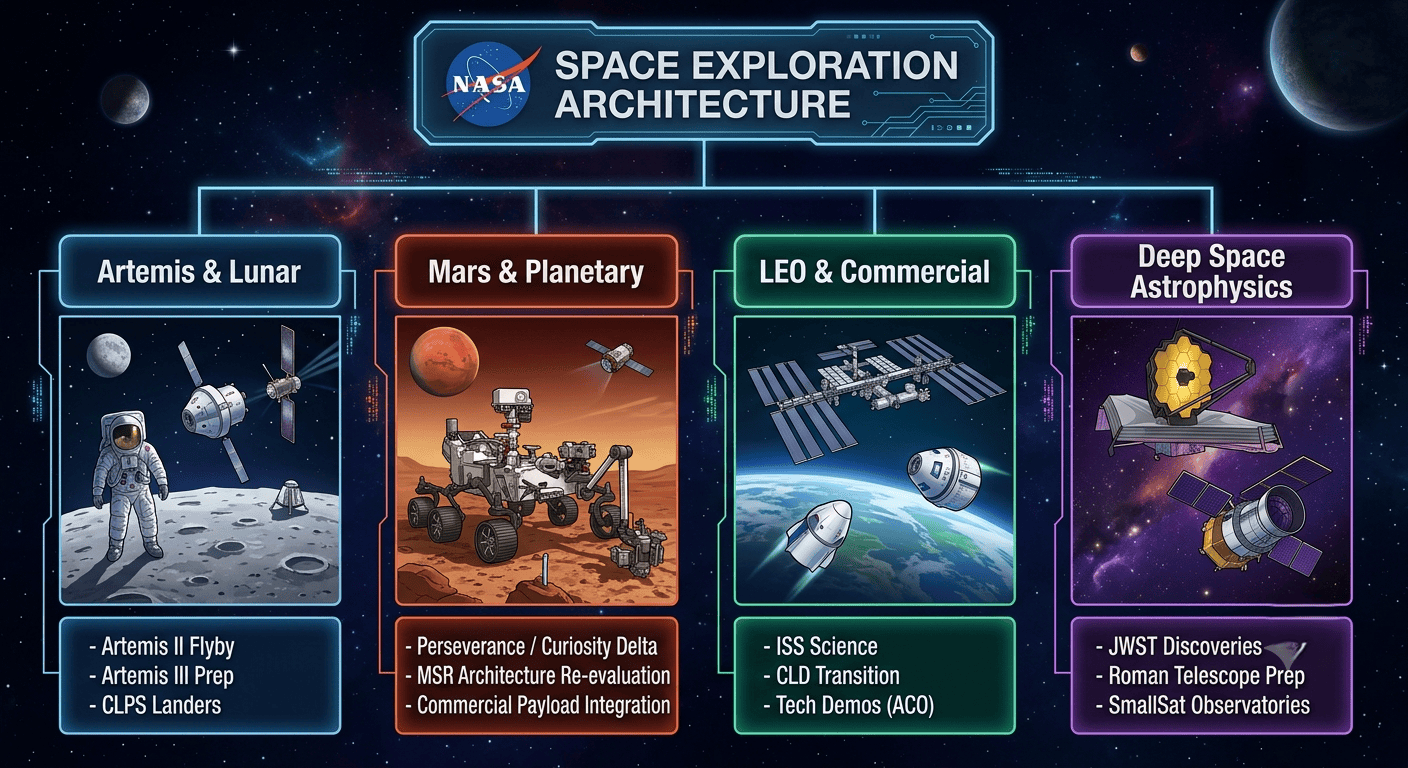

Space exploration has entered a historic era. From humanity’s long-awaited return to lunar orbit with astronauts to next-generation space telescopes and gravity-assist slingshots across the solar system, NASA’s slate of missions showcases immense technical ambition.
This comprehensive guide breaks down the most significant NASA space events, their operational mechanics, scientific goals, and long-term implications for cosmic discovery.
                        [ 2026 NASA EXPLORATION MATRIX ]
                                       |
    +-------------------+--------------+--------------+-------------------+
    |                   |                             |                   |
[ CREWED FLIGHT ]   [ ASTROPHYSICS ]               [ DEEP SPACE ]     [ COMMERCIAL FLEET ]
 - Artemis II        - Nancy Grace Roman Telescope  - Europa Clipper   - CLPS Moon Landers
   Lunar Flyby         Launch to L2 Halo Orbit        Earth Slingshot    (Astrobotic, IM, Firefly)
1. Artemis II: Humanity’s Crewed Return to Lunar Orbit
Among all spaceflight milestones, none stands taller than Artemis II, the first crewed mission to the vicinity of the Moon since Apollo 17 in 1972.

       [ EARTH ]
           |
           |---> Trans-Lunar Injection (TLI Burn)
           |---> 10-Day Hybrid Free-Return Trajectory
           v
       [ MOON ]  (Passes ~6,500 km above lunar surface)
           |
           |---> Gravity slingshot pulls Orion back to Earth
           v
       [ PACIFIC OCEAN SPLASHDOWN ]
Mission Overview & Execution
Core Mission Accomplishments
Why Artemis II Matters
Artemis II proved that NASA’s heavy-lift launch architecture and deep-space crew module are fully flight-rated for human life. The operational data collected during this 10-day trek provides the baseline needed for subsequent crewed surface landing missions at the Lunar South Pole.
2. Launch of the Nancy Grace Roman Space Telescope
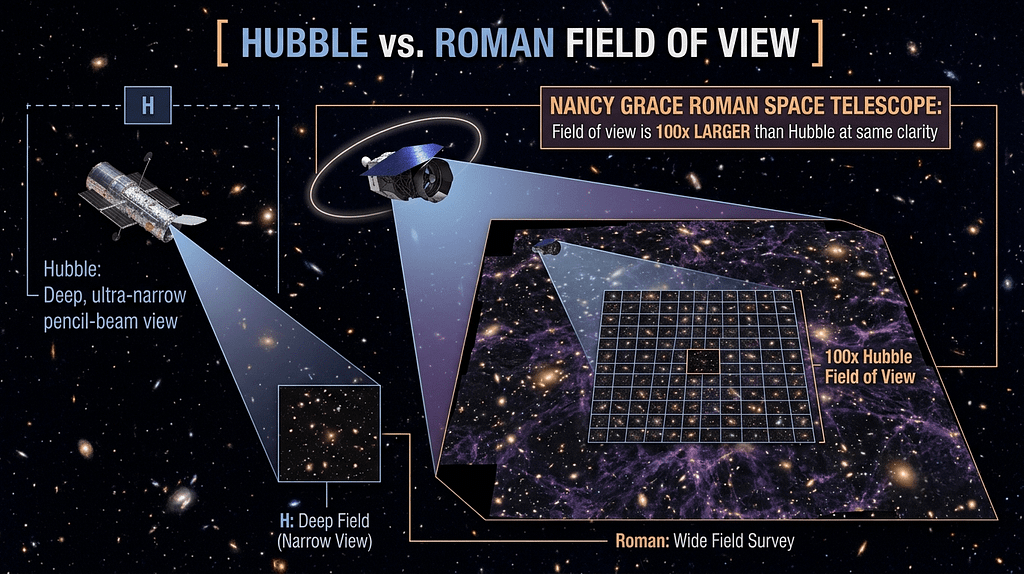
For optical and infrared astrophysics, the launch of the Nancy Grace Roman Space Telescope (named after NASA’s first Chief of Astronomy) marks a massive technical leap beyond Hubble and the James Webb Space Telescope (JWST).
                     [ HUBBLE vs. ROMAN FIELD OF VIEW ]

    +---+
    | H |  <-- Hubble: Deep, ultra-narrow pencil-beam view
    +---+

    +-------------------------------------------------------------+
    |                                                             |
    |  NANCY GRACE ROMAN SPACE TELESCOPE                          |
    |  Field of view is 100x LARGER than Hubble at same clarity    |
    |                                                             |
    +-------------------------------------------------------------+
Launch & Mission Parameters
- Target Launch Date: August 30, 2026
- Launch Vehicle: SpaceX Falcon Heavy
- Destination: Sun-Earth Lagrange Point 2 (L2), situated 1.5 million kilometers (1 million miles) from Earth.
- Primary Optics: 2.4-meter primary mirror equipped with a 300-megapixel Wide-Field Instrument (WFI) and a Coronagraph Instrument (CGI) demonstration.
Scientific Objectives
3. Europa Clipper’s Earth Gravity Assist Slingshot
NASA’s flagship astrobiology mission to Jupiter’s icy moon Europa—launched in late 2024—reaches a critical navigational milestone. To gain the speed necessary to reach the Jovian system by 2030, Europa Clipper uses a Mars-Earth Gravity Assist (MEGA) trajectory.
                [ MARS-EARTH GRAVITY ASSIST (MEGA) ]

1. Launch (Oct 2024) ---> 2. Mars Flyby (Feb 2025) ---> 3. Earth Flyby (Dec 2026) ---> 4. Jupiter Arrival (2030)
                                                                 |
                                                     Passes ~3,200 km above Earth
                                                     Gains critical velocity boost
Earth Flyby Details
- Event Date: December 1–3, 2026
- Closest Approach Altitude: Approximately 3,200 kilometers (2,000 miles) above Earth’s surface.
- Mechanism: The spacecraft uses Earth’s gravitational well to trade orbital momentum with the planet, accelerating the probe into a high-speed trajectory directed toward Jupiter.
Strategic Significance
Even with massive rockets like Falcon Heavy, launching a 6,000 kg spacecraft directly to Jupiter would require far more chemical propellant than the vehicle could carry. The December 2026 Earth flyby provides the kinetic energy boost required for its 2030 arrival at Jupiter. Once in orbit around Jupiter, Clipper will perform 49 close flybys of Europa, using ice-penetrating radar, infrared spectrometers, and magnetometers to analyze whether Europa’s sub-surface liquid water ocean could foster conditions for life.
4. Robotic Lunar Fleet: CLPS Surface Deliveries
Under the Commercial Lunar Payload Services (CLPS) framework, NASA partners with private American aerospace firms to deliver scientific payloads, autonomous rovers, and technology demonstrations to the Moon.
                     [ 2026 CLPS LANDER FLEET ]
                                  |
     +----------------------------+----------------------------+
     |                            |                            |
[ Astrobotic Griffin-1 ]   [ Intuitive Machines IM-3 ]   [ Firefly Blue Ghost 2 ]
 - Heavy Payload Delivery   - Reiner Gamma Anomaly        - Far Side / South Pole
 - Polar Volatiles Scan     - Swarm Rover Deployment      - Lunar Communications
Major CLPS Missions
Primary Scientific Goals
5. In-Space Servicing & Specialized Science SmallSats
NASA’s technological footprint extends beyond flagships to include orbital servicing and low-cost SmallSat constellations.
| Mission / Payload                  | Launch Period               | Mission Purpose
| Pandora Space Telescope            | January 2026 (Launched)     | Multi-wavelength transit spectroscopy of exoplanets|
| SPARCS & BlackCAT SmallSats        | January 2026 (Launched)     | Stellar flare observations & X-ray transient hunting|
| RSGS In-Space Servicing Payload    | July 21, 2026 (Launched)    | Robotic repair, refueling & orbital servicing    |
Robotic Servicing of Geosynchronous Satellites (RSGS)
- Launch Date: July 21, 2026
- Partnership: NASA, DARPA, Northrop Grumman, and the U.S. Naval Research Laboratory.
- Core Technology: Hosted aboard Northrop Grumman’s Mission Robotic Vehicle (MRV), the RSGS payload features two dexterous robotic arms designed to perform close-proximity inspection, mechanical repairs, structural enhancements, and hardware installations on satellites operating in geosynchronous orbit (35,786 km altitude).
- Impact: RSGS establishes a framework for modular satellite upgrades, orbital debris reduction, and in-space manufacturing, shifting satellite operations away from “disposable” hardware models.
Astrophysics SmallSat Constellations
6. Summary Timeline of 2026 NASA Milestones
| Date / Window     | Mission / Event                          | Key Objective
+-------------------+------------------------------------------+-----------------------------
| January 2026      | Pandora, SPARCS & BlackCAT Launch        | Exoplanet & stellar astrophysics SmallSat deployment  |
| April 1–10, 2026  | Artemis II Crewed Lunar Mission          | First crewed flight around the Moon since 1972  |
| Mid-2026          | CLPS Commercial Moon Flights             | Robotic surface landers & rover deployments   |
| July 21, 2026     | RSGS Satellite Servicing Launch          | In-space robotic arm servicing in GEO orbit     |
| August 30, 2026   | Nancy Grace Roman Telescope Launch       | Wide-field infrared dark energy & exoplanet survey   |
| December 1–3, 2026| Europa Clipper Earth Gravity Assist     | Gravity slingshot maneuver en route to Jupiter  |
1: What made the Artemis II mission a major stepping stone for human space exploration?
Artemis II served as the crucial crewed operational bridge between the uncrewed flight test of Artemis I and future surface landing missions. Carrying four astronauts—Reid Wiseman, Victor Glover, Christina Koch, and Jeremy Hansen—it tested life support systems, crew cabin ergonomics, manual piloting controls, and high-frequency communication arrays in deep space.
By successfully sending Orion through a lunar free-return trajectory and executing a high-speed atmospheric entry, NASA confirmed that its Space Launch System (SLS) rocket and Orion spacecraft can safely transport human crews to deep space and return them to Earth.
2: How does the Nancy Grace Roman Space Telescope complement the James Webb Space Telescope (JWST)?
Roman and JWST are designed to perform complementary astronomical roles:
3: Why did the Europa Clipper spacecraft need to perform an Earth Gravity Assist flyby in December 2026?
Europa Clipper is a massive, 6,000 kg spacecraft equipped with heavy scientific instruments and a solar array spanning over 30 meters (100 feet). Rocket systems cannot carry enough onboard fuel to propel a payload of this size directly to Jupiter on a straight-line trajectory.
To reach the necessary speed, flight dynamics engineers use a Mars-Earth Gravity Assist (MEGA) trajectory:
- The spacecraft launched in October 2024 and completed a close pass of Mars in early 2025.
- In December 2026, it swings back around Earth at an altitude of 3,200 km.
- During this flyby, Earth’s orbital gravity slingshots the spacecraft forward, giving it the final boost of speed needed to reach Jupiter in 2030 without expending chemical fuel.
4: What is the Commercial Lunar Payload Services (CLPS) program, and why is NASA using it?
CLPS is a NASA contract model where the agency hires commercial aerospace companies (such as Intuitive Machines, Astrobotic, and Firefly Aerospace) to transport scientific experiments, technology payloads, and rovers to the Moon.
Instead of NASA building, launching, and managing the landers directly, commercial partners build and operate the spacecraft themselves. NASA simply buys payload space onboard. This approach:
- Reduces mission costs through competitive fixed-price contracts.
- Increases the frequency of landing missions on the lunar surface.
- Accelerates technological development for harvesting lunar resources (like water ice) and protecting equipment from abrasive lunar dust.
5: What is the Robotic Servicing of Geosynchronous Satellites (RSGS) payload, and why is in-space servicing important?
Launched on July 21, 2026, RSGS is an advanced robotic servicing payload developed through a collaboration between NASA, DARPA, the U.S. Naval Research Laboratory, and Northrop Grumman. Mounted on a host spacecraft operating in geosynchronous orbit (35,786 km above Earth), RSGS features two multi-jointed robotic arms.
RSGS can perform orbital inspections, execute mechanical repairs, install payload upgrades, and assist with orbit corrections. In-space servicing extends the operational lifespan of high-value satellites, reduces orbital debris, and paves the way for assembling large telescopes and structures directly in space.
6: How do SmallSats like Pandora, SPARCS, and BlackCAT support space discovery alongside massive flagship missions?
Large flagship missions like JWST and Roman are high-demand observatories with strict scheduling constraints. SmallSats (CubeSats and small satellites) provide low-cost, targeted observational capability:
SmallSats complement flagship observatories by providing dedicated, single-purpose long-term tracking at a fraction of the cost.
Looking Ahead
NASA’s accomplishments across deep space, astrophysics, orbital servicing, and lunar exploration demonstrate a clear strategic vision.
By pairing government-led flagship missions like Artemis II and the Nancy Grace Roman Space Telescope with commercial partnerships like CLPS and RSGS, NASA continues to expand human capabilities, build lasting space infrastructure, and deepen our understanding of the universe.
Next Post:New Moon, Mars, and Deep Space Mission Updates