
NASA’s space exploration strategy represents a major evolution in how humanity reaches into the solar system. Guided by a dual framework of crewed exploration and robotic discovery, the agency is establishing infrastructure on and around the Moon, preparing long-term architectures for Mars, expanding commercial LEO (Low Earth Orbit) ecosystems, and using space observatories to study deep cosmic phenomena.
This report provides a comprehensive overview of NASA’s current operations, strategic shifts, commercial partnerships, and deep-space missions across several core areas of exploration.

                       [ NASA SPACE EXPLORATION ARCHITECTURE ]
                                          |
   +-----------------------+--------------+-----------------------+-----------------------+
   |                       |                                      |                       |
[ Artemis & Lunar ]   [ Mars & Planetary ]                  [ LEO & Commercial ]   [ Deep Space Astrophysics ]
 - Artemis II Flyby    - Perseverance / Curiosity Delta      - ISS Science            - JWST Discoveries
 - Artemis III Prep    - MSR Architecture Re-evaluation       - CLD Transition         - Roman Telescope Prep
 - CLPS Landers        - Commercial Payload Integration       - Tech Demos (ACO)       - SmallSat Observatories
1. Human Lunar Exploration: The Artemis Architecture
The Artemis Program forms the central pillar of NASA’s crewed exploration strategy. Its overarching goal is to establish a sustained human presence on the Moon and pave the way for human missions to Mars.
Artemis II: The First Crewed Deep-Space Mission in Decades
A major milestone for NASA was the successful execution of Artemis II, marking humanity’s return to the lunar vicinity for the first time since Apollo 17 in 1972.
- Crew Composition: The four-person crew comprised Commander Reid Wiseman, Pilot Victor Glover, and Mission Specialist Christina Koch from NASA, along with Mission Specialist Jeremy Hansen from the Canadian Space Agency (CSA).
- Mission Profile: Launched atop the Space Launch System (SLS) Block 1 rocket, the Orion spacecraft (named Integrity) flew a 10-day hybrid free-return trajectory around the Moon.
- Technical Objectives: The mission systematically tested Orion’s Environmental Control and Life Support Systems (ECLSS), manual piloting capabilities in high Earth orbit, deep-space optical communications, and high-speed atmospheric re-entry dynamics.
- Impact: Telemetry gathered during Artemis II validated primary spacecraft systems, providing baseline operational data required for landing hardware.
Artemis II Mission Phase Breakdown
+--------------------------------+-------------------------------------------------------+
| Mission Phase                  | Operational Focus                                     |
+--------------------------------+-------------------------------------------------------+
| Earth Orbit Systems Checkout   | Manual proximity maneuvers and ECLSS validation       |
| Trans-Lunar Injection (TLI)    | SLS ICPS burn pushing Orion onto lunar trajectory     |
| Lunar Flyby                    | Free-return pass (~6,500 km altitude above surface)   |
| Trans-Earth Return             | Guidance and trajectory adjustments toward splashdown |
| Re-Entry & Recovery            | High-speed skip entry into the Pacific Ocean          |
+--------------------------------+-------------------------------------------------------+
Strategic Realignment and Prep for Artemis III
Following the success of Artemis II, NASA announced key updates to its long-term Artemis flight manifest and hardware development strategy:
- Surface-First Infrastructure: Program priorities have been adjusted to focus heavily on foundational surface capabilities—such as surface power systems, dust mitigation, and life support logistics—to enable sustained operations at the Lunar South Pole.
- Complex Multi-Spacecraft Operations for Artemis III: Designed as a precursor test before long-duration surface stays, Artemis III incorporates complex rendezvous operations. The mission profile involves launching the Orion spacecraft into orbit to meet and conduct operational tests with commercial human landing systems (HLS)—including SpaceX’s Starship HLS and Blue Origin’s Blue Moon lander.
- In-Space Propellant Transfer: NASA is closely monitoring commercial demonstrations of in-space cryogenic propellant transfer, a prerequisite technology for heavy-class landers traveling to deep-space destinations.
2. Robotic Lunar Infrastructure & CLPS Fleet
Alongside crewed flights, NASA’s Commercial Lunar Payload Services (CLPS) initiative uses competitive, fixed-price contracts to deliver scientific payloads and technological demonstrations directly to the lunar surface.
                     [ CLPS DELIVERIES TO THE MOON ]
                                    |
     +------------------------------+------------------------------+
     |                              |                              |
[ Lunar South Pole ]       [ Commercial Landers ]        [ Tech Demonstrations ]
 - Water-ice mapping        - Blue Origin Mark I          - Autonomous Rovers
 - PSR subsurface radar     - Intuitive Machines Nova-C   - Dust Mitigation & ISRU
 - Volatile sampling        - Firefly Aerospace           - Laser Communications
Key Commercial Delivery Objectives
- Blue Origin (Blue Moon Pathfinder / Mark I): Deploying the Endurance lander to test landing dynamics, precision hazard avoidance, and plume-surface interactions on the regolith.
- Intuitive Machines & Firefly Aerospace: Flying payloads to investigate sub-surface volatile distribution, local magnetic anomalies, and radio astronomy from the lunar surface.
- Autonomous Micro-Rovers: Testing swarm robotics—such as the CADRE (Cooperative Autonomous Distributed Robotic Exploration) network—to autonomously map terrain, measure magnetic fields, and demonstrate multi-agent coordination without direct operator intervention.
In-Situ Resource Utilization (ISRU) & Technology Collaborations
NASA’s Announcement of Collaboration Opportunity (ACO) has funded dozens of U.S. industrial initiatives. These public-private partnerships focus on:
- Regolith Processing: Extraction techniques to isolate oxygen and hydrogen from lunar soil for life support and propellant manufacturing.
- Dust Mitigation: Electrostatic and physical shield technologies to protect seal joints, spacesuit visors, and optical equipment from abrasive lunar dust.
- Surface Power Systems: Lightweight, deployable solar arrays and compact fission surface power systems designed to survive the 14-day lunar night.
3. Mars Exploration: Science & Strategy
NASA’s Mars Exploration Program balances active robotic science on the surface with structural planning for sample return and human precursor concepts.
                          [ MARS EXPLORATION VECTOR ]
                                       |
    +----------------------------------+----------------------------------+
    |                                                                     |
[ Active Surface Science ]                                    [ Next-Gen Architecture ]
 - Perseverance: Jezero Delta Cores                            - Commercial Mars Payload Concepts
 - Curiosity: Mount Sharp Sulfate Units                        - Scaled Entry, Descent, Landing (EDL)
 - Atmospheric & Biosignature Profiling                        - Re-evaluated Mars Sample Return (MSR)
Perseverance & Curiosity Surface Operations
- Jezero Crater (Perseverance): The Perseverance rover has built an extensive collection of rock cores, regolith samples, and atmospheric canisters. Exploring Jezero’s fan-delta, the rover’s SHERLOC (Scanning Habitable Environments with Raman & Luminescence for Organics & Chemicals) and PIXL (Planetary Instrument for X-ray Lithochemistry) instruments have mapped fine-scale organic compounds and hydrous minerals that preserve markers of past aqueous environments.
- Gale Crater (Curiosity): Curiosity continues its ascent up Mount Sharp, analyzing transitioning geological layers from clay-bearing clays to magnesium and calcium sulfates. This transition documents how Mars shifted from a warm, water-rich planet to a cold desert world billions of years ago.
Restructuring Mars Sample Return (MSR)
To address cost and complexity, NASA initiated a strategic overhaul of the Mars Sample Return program:
- Architecture Optimization: NASA launched an agency-wide effort seeking innovative, lower-cost, and shorter-timeline options from both internal centers and commercial aerospace partners.
- Commercial Integration: By evaluating commercial launch platforms, simplified ascent vehicles, and modular sample collection craft, NASA aims to bring Perseverance’s core samples to Earth laboratories while optimizing capital expenditure.
4. Low Earth Orbit (LEO) Economy & Space Station Transition
As the International Space Station (ISS) approaches its final operational decade, NASA is fostering a self-sustaining commercial ecosystem in Low Earth Orbit.
                     [ LOW EARTH ORBIT TRANSITION ]
                                    |
    +-------------------------------+-------------------------------+
    |                                                               |
[ ISS Continuous Operations ]                      [ Commercial LEO Destinations (CLDs) ]
 - Microgravity Research                            - Private Space Station Modules
 - In-Space Manufacturing                           - Commercial Crew & Cargo Supply
 - Technology Risk Reduction                        - Autonomous Free-Flying Platforms
ISS Microgravity Science
The ISS continues to operate as an active orbiting laboratory. Key NASA research priorities on the station include:
- Human Research Program (HRP): Studying long-duration physiological changes in microgravity—including fluid shifts, bone density loss, ocular changes, and radiation mitigation—to safeguard crews on multi-year deep-space journeys.
- In-Space Manufacturing & Material Science: Testing physical processes such as protein crystal growth, high-purity optical fiber production (ZBLAN), and tissue engineering under continuous microgravity conditions.
Commercial LEO Destinations (CLD) Program
To maintain continuous American crew presence in LEO without interruption after the retirement of the ISS, NASA is partnering with commercial builders developing private space stations:
- Development Phase: Supporting design maturity and safety certification for commercial habitats proposed by industry consortiums (including Axiom Space, Starlab Space, and Vast).
- Service-Based Model: NASA plans to operate as one of many commercial customers purchasing crew time, cargo volume, and laboratory space on private stations, lowering fixed operational overhead.
5. Planetary Defense, Astrophysics & Deep Space Science
NASA’s science fleet covers targets across the entire solar system and deep space, using orbiting observatories, interplanetary cruisers, and small-satellite constellations.
+---------------------------+-------------------------------+--------------------------------------------+
| Mission                   | Target / Location             | Primary Science Objective                  |
+---------------------------+-------------------------------+--------------------------------------------+
| James Webb (JWST)         | Sun-Earth L2 Point            | Cosmic Dawn, Exoplanet Spectroscopy        |
| Europa Clipper            | Interplanetary (Jupiter Bound)| Ocean World Habitability Assessment        |
| Psyche Spacecraft         | Asteroid Belt (via Mars)      | Metallic Planetary Core Characterization   |
| Pandora / SPARCS SmallSats| Low Earth Orbit               | Exoplanet Atmospheres & Stellar Flares     |
| Roman Space Telescope     | Integration / Launch Prep     | Dark Energy, Dark Matter, Microlensing     |
+---------------------------+-------------------------------+--------------------------------------------+
Deep Space Flagships: Europa Clipper & Psyche
- Europa Clipper: Having departed Earth on its multi-year cruise to Jupiter, Europa Clipper continues its trajectory maneuvering. Following a precision Mars Gravity Assist flyby, the probe is aligned for a major Earth Gravity Assist maneuver to gain the kinetic energy needed to enter the Jovian system and conduct 49 low-altitude flybys of the ocean moon Europa.
- Psyche Mission: En route to the metallic asteroid 16 Psyche, the spacecraft is demonstrating high-efficiency Hall-effect solar electric propulsion while testing Deep Space Optical Communications (DSOC) over extreme interplanetary distances.
Astrophysics Flagships & Small Satellite Fleets
- James Webb Space Telescope (JWST): Operating at Lagrange Point 2 ($L_2$), JWST continues to deliver breakthroughs:
- Early Cosmic Evolution: Capturing galaxies with redshifts exceeding $z > 14$, offering insights into star formation shortly after the Big Bang.
- Exoplanetary Atmospheres: Detecting water vapor, carbon dioxide, methane, and photochemically driven sulfur dioxide clouds across alien worlds.
- Targeted Astrophysics SmallSats: NASA launched small astrophysics missions, including the Pandora SmallSat (dedicated to studying stellar contamination in exoplanet atmospheric spectra) alongside the SPARCS and BlackCAT CubeSats.
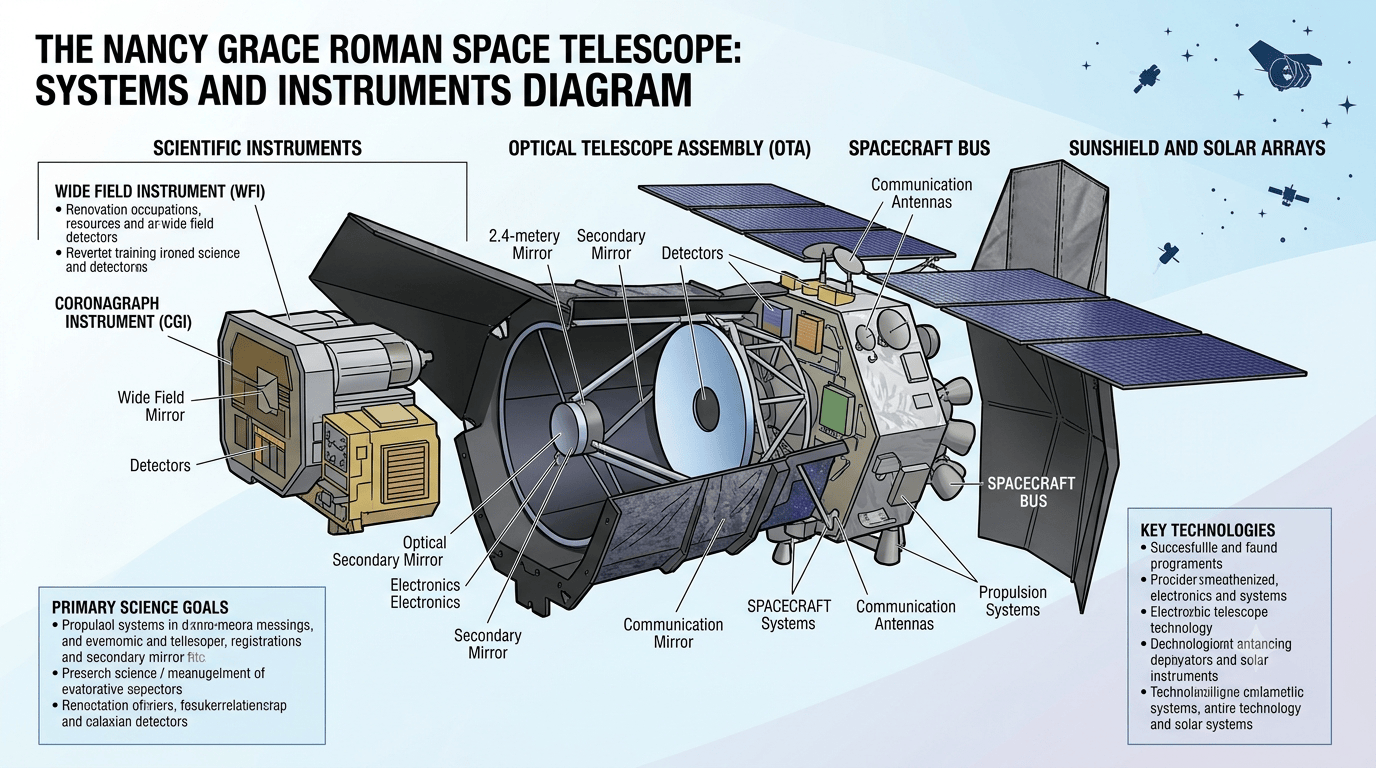
- Nancy Grace Roman Space Telescope: NASA is completing final integration and testing on the Roman Space Telescope. Designed with a wide-field field of view 100 times larger than Hubble’s, Roman will perform large-scale surveys to map dark energy, map dark matter distributions, and conduct a Galactic Bulge Microlensing Survey to discover thousands of nested exoplanets.
Q1: What was the primary objective of NASA’s Artemis II mission, and why was it significant?
Artemis II was the first crewed test flight of the Artemis program, designed to evaluate the operational capabilities of the Space Launch System (SLS) rocket and the Orion spacecraft with astronauts aboard.
Its primary objective was to validate life-support systems (ECLSS), manual piloting, communications, and emergency abort procedures in real deep-space conditions during a 10-day lunar flyby. It marked the first time human beings traveled beyond Low Earth Orbit since the Apollo 17 mission in 1972, providing empirical operational data needed for future lunar landing missions.
2: How does NASA’s Commercial Lunar Payload Services (CLPS) model work, and how does it differ from traditional space missions?
Under traditional NASA programs, the agency directly designed, owned, and operated the spacecraft, taking full oversight of contractor workflows.
Under the CLPS initiative, NASA operates as a commercial buyer. Private companies (such as Intuitive Machines, Blue Origin, and Firefly Aerospace) build, own, launch, and operate their own lunar landers. NASA purchases payload space on these landers to transport scientific instruments to the Moon. This commercial model reduces costs per payload, encourages a private space ecosystem, and allows NASA to conduct frequent, low-cost scientific investigations across diverse lunar landing sites.
3: What is NASA’s long-term plan for maintaining a presence in Low Earth Orbit after the International Space Station (ISS) is retired?
Rather than constructing a government-owned direct replacement for the ISS, NASA is implementing its Commercial LEO Destinations (CLD) strategy.
The agency provides seed funding and technical guidance to private companies (such as Axiom Space, Starlab Space, and Vast) developing commercial orbital stations. Once operational, NASA will purchase research modules, crew accommodations, and laboratory facilities on these commercial platforms as a customer. This approach maintains continuous U.S. presence and scientific access to microgravity environments while allowing NASA to direct a larger portion of its budget toward deep-space human missions to the Moon and Mars.
4: Why is NASA re-evaluating the Mars Sample Return (MSR) architecture?
Independent assessments of the baseline Mars Sample Return concept—which required a complex sequence involving a retrieval lander, a Mars Ascent Vehicle, an Earth Return Orbiter, and sample capture hardware—showed projected costs reaching up to $11 billion alongside potential timeline delays stretching past 2040.
To avoid impacting other planetary science missions, NASA initiated an agency-wide re-evaluation. The updated strategy focuses on adopting streamlined, lower-cost architectures and leveraging innovations from commercial aerospace partners to safely return Perseverance’s collected rock cores to Earth faster and within a more sustainable budget framework.
5: What makes the upcoming Nancy Grace Roman Space Telescope different from the James Webb Space Telescope (JWST)?
While both are flagship space observatories operating at the Sun-Earth $L_2$ point, they serve complementary scientific roles:
- Field of View: JWST is a narrow-field observatory designed for deep, high-resolution pointing at individual targets (e.g., early galaxies or specific exoplanets). The Roman Space Telescope features a wide-field camera with a field of view 100 times larger than Hubble’s at comparable resolution.
- Primary Mission: Roman is designed for wide-area statistical surveys. It will map billions of galaxies to measure cosmic expansion, analyze the distribution of dark matter and dark energy across cosmic time, and perform wide-field gravitational microlensing surveys to discover thousands of planetary systems.
6: How does NASA plan to address power requirements for long-duration surface stays on the Moon?
To survive the 14-day lunar night—where temperatures drop below $-130^\circ\text{C}$—solar power alone is insufficient for sustained base camp operations.
NASA is pursuing a multi-tier strategy:

- Vertical Solar Arrays: Deploying specialized, tall solar arrays positioned on high topographic peaks near the Lunar South Pole (“Peaks of Eternal Light”) that receive nearly continuous sunlight.
- Fission Surface Power (FSP): Partnering with the Department of Energy and private contractors to build compact, 40-kilowatt-class nuclear fission reactors. These reactors can provide reliable, continuous electrical power for life support, charging rovers, and running fuel generation plants regardless of shadow or location.
- Advanced Battery Systems: Investing in high-density thermal and chemical batteries capable of operating in extreme low-temperature environments.
7. Summary & Strategic Outlook
NASA’s strategy reflects a modern approach to space exploration:
                                [ STRATEGIC GOALS OUTLOOK ]
                                             |
         +-----------------------------------+-----------------------------------+
         |                                   |                                   |
 [ SUSTAINED LUNAR BASE ]            [ DEEP SPACE KNOWLEDGE ]            [ COMMERCIAL ECOSYSTEM ]
 - Surface Infrastructure & Power    - Cosmic Evolution & Dark Energy    - Private Orbiting Stations
 - Resource Extraction (ISRU)        - Ocean World Habitability           - Public-Private Lunar Deliveries
 - Human Precursors for Mars         - Direct Exoplanet Characterization  - Scaled Space Economy
Next Post:New Moon, Mars, and Deep Space Mission Updates