

For decades, small business owners across the United States faced a persistent operational handicap: enterprise competitors possessed vast teams, multimillion-dollar technology budgets, and dedicated data science departments. Main Street coffee shops, local HVAC contractors, independent accounting firms, and boutique e-commerce stores simply could not compete with that scale.
Today, that technological gap is closing faster than during any previous technology cycle. The rapid rise of accessible artificial intelligence (AI) tools—from large language models (LLMs) to autonomous AI agents—has handed small-and-medium-sized businesses (SMBs) equalizing capabilities.
The Numbers Behind the Main Street AI Shift
Small business AI adoption in the United States has shifted from experimental dabbling to core operational integration. Recent data highlights how swiftly American entrepreneurs are embracing these technologies:
  Traditional Enterprise Advantage          The Modern AI Equalizer
 ┌────────────────────────────────┐        ┌────────────────────────────────┐
 │ • Custom Enterprise Software   │   VS   │ • On-Demand AI Copilots        │
 │ • Massive Dedicated Staff      │        │ • Automated Workflows          │
 │ • Multi-Million Dollar Capital │        │ • Enterprise Tools at $20/mo   │
 └────────────────────────────────┘        └────────────────────────────────┘
4 Key Operational Pillars Transformed by AI
Small business owners rarely care about technology for its own sake; they care about saving time, reducing overhead, and winning customers. AI delivers tangible impact across four primary operational areas:
1. Speed-to-Lead and Customer Service
In local service industries—plumbing, legal, roofing, dental, and consulting—speed determines who wins the job. Research shows that 78% of customers hire the company that responds first when shopping between service providers.
Traditionally, small business owners lost roughly 27% of incoming calls because they were on job sites or assisting other clients. AI-driven phone receptionists and automated SMS agents now resolve this issue:
- Instant Missed-Call Recovery: When a call goes unanswered, an AI agent instantly texts the potential customer, answers initial questions, assesses their needs, and schedules an appointment directly into the calendar.
- 24/7 Availability: AI chatbots handle routine inquiries—such as store hours, pricing tiers, and service coverage—outside standard working hours, capturing leads that previously bounced to competitors.
Real-World Impact: Response times drop from an industry average of 42 minutes down to under 2 minutes, lifting lead conversion rates from 28% to over 60%.
2. Hyper-Personalized Marketing and Sales
Small business marketing historically relied on broad local advertising or static email blasts. AI brings enterprise-level audience segmentation and personalized content generation within reach for non-technical owners.
3. Back-Office Operations and Financial Management
Administrative tasks like bookkeeping, invoicing, inventory tracking, and contract drafting can easily consume 15 to 20 hours of a business owner’s week. AI acts as a virtual back-office assistant, streamlining these routine processes:
- Automated Bookkeeping: Modern accounting platforms use OCR (Optical Character Recognition) combined with machine learning to scan receipts, categorize expenses, match bank statements, and alert owners to unusual spending patterns.
- Predictive Inventory Management: Retailers and restaurants use machine learning to forecast demand based on historical sales, local weather forecasts, and regional events, preventing costly overstock or inventory shortages.
- Contract and Invoice Processing: AI tools review supplier contracts for unfavorable terms and automatically issue automated invoice reminders to overdue accounts, improving cash flow.
4. HR, Onboarding, and Staff Productivity
Finding and retaining quality talent remains a top challenge for U.S. small businesses. AI streamlines workforce management without eliminating the human touch:
- Resume Screening: AI tools parse candidate applications, highlighting the top 10% based on skill matching, reducing time-to-hire by days.
- Internal Knowledge Assistants: Companies upload training manuals, standard operating procedures (SOPs), and equipment specifications into custom AI knowledge bases. Employees can ask plain-English questions like “How do I recalibrate the Model 4 compressor?” and receive step-by-step guidance instantly.
Comparative Breakdown: Traditional vs. AI-Powered Operations
| Operational Function | Traditional Small Business Approach | AI-Enhanced Approach | Average Impact |
| Lead Response | Call back when off the job site (1 to 24-hour delay) | Instant AI text/call acknowledgment (<2 minutes) | +60% higher lead conversion |
| Content & Ads | Write updates manually or hire an expensive agency | AI drafts blogs, social posts, and ad campaigns | 5–15 hours saved weekly |
| Customer Support | Answer phones during business hours only | 24/7 conversational AI support agents | $3.50 ROI per $1 spent |
| Bookkeeping | Manual entry into spreadsheets late at night | Automated expense categorization and reconciliation | 70% drop in accounting errors |
| E-Commerce Sales | Static store layouts and general discount banners | Dynamic personalized product recommendations | +25–35% higher store revenue |
Key Challenges and How Successful SMBs Overcome Them
Despite these rapid gains, AI adoption is not without friction. A significant portion of business owners remain hesitant or struggle with implementation.

               ┌────────────────────────────────────────────────────────┐
               │         Primary Barriers to AI Adoption (SMBs)         │
               └────────────────────────────────────────────────────────┘
                                           │
       ┌───────────────────┬───────────────┴───────────────┬───────────────────┐
       ▼                   ▼                               ▼                   ▼
┌──────────────┐   ┌──────────────┐                 ┌──────────────┐   ┌──────────────┐
│  Perceived   │   │     Lack     │                 │ Security &   │   │ Unclear ROI  │
│ Irrelevance  │   │  of Expertise│                 │ Privacy      │   │ Expectations │
│    (77%)     │   │    (60%)     │                 │   (38%)      │   │    (34%)     │
└──────────────┘   └──────────────┘                 └──────────────┘   └──────────────┘
1. The “Relevance Gap”
Studies show that 77% of non-adopting small businesses believe AI is not applicable to their industry. This misconception often stems from viewing AI as futuristic robotics rather than practical automation tools like automated scheduling or instant lead replies.
- The Solution: Start small with high-impact, low-complexity use cases—such as an AI assistant for drafting customer emails or answering missed phone calls.
2. Data Privacy and Security Concerns
Small business owners frequently worry that entering sensitive customer or financial data into AI models could lead to privacy breaches.
- The Solution: Opt for enterprise-grade software versions that guarantee user data is not used to train public models. Enforce clear internal policies regarding what information can be shared with AI systems.
3. Avoiding “Tool Fatigue”
With thousands of new AI tools launching every year, entrepreneurs often get overwhelmed trying to stitch together disconnected applications.
- The Solution: Instead of adopting dozens of standalone tools, leverage AI features built directly into existing software platforms—such as QuickBooks, Shopify, HubSpot, or Canva.
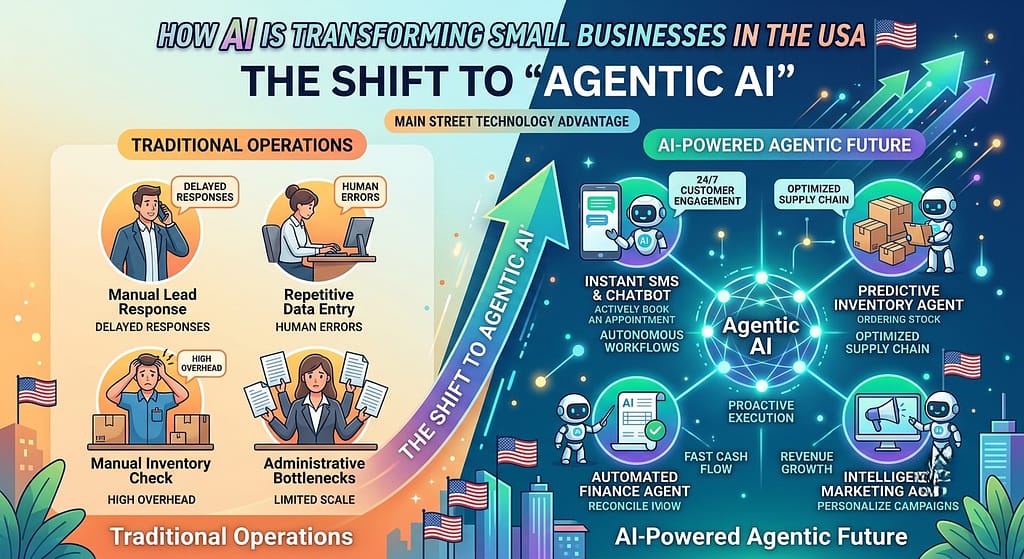
Looking Ahead: The Shift to “Agentic AI”
The next frontier for small businesses is the transition from Generative AI (tools that draft text or create images) to Agentic AI (autonomous systems that execute complex multi-step workflows).
Instead of simply drafting a response to a customer complaint, an AI agent can:
- Parse the customer’s email and analyze tone.
- Check internal inventory and order histories.
- Automatically issue a replacement order or refund.
- Notify the warehouse manager.
- Draft a customized follow-up email for final human approval.
By deploying autonomous agents for repetitive workflows, small teams can operate with the output capacity of companies many times their size.
1: Is AI too expensive for a small business with a tight budget?
No. One of the greatest advantages of modern AI is its low financial barrier to entry. Most foundational tools—such as ChatGPT, Claude, or Google Gemini—offer robust free tiers, with paid professional plans starting around $20 per user per month. Furthermore, many existing business applications (like CRM and accounting software) include built-in AI features at no additional charge. Average micro-business budgets for AI tooling range from $500 to $1,500 annually, yielding measurable hours saved.
2: Will implementing AI replace my existing staff?
In most small businesses, AI acts as an multiplier rather than a replacement. Small teams are rarely overstaffed; instead, workers are often bogged down by administrative tasks like data entry, scheduling, and invoice chasing. By automating these repetitive chores, AI enables existing employees to focus on high-value human activities—building client relationships, solving complex customer issues, and driving strategic growth.
3: How do I know which AI tool to implement first?
Follow the “Pain Point Rule.” Identify where your business experiences the most friction or lost revenue:
4: Do I need technical or coding skills to use AI effectively?
No technical skills are required. Modern AI applications feature natural language interfaces, meaning you interact with them using normal, conversational English. If you know how to send a text message or perform a search online, you possess all the technical skill necessary to use most small business AI tools effectively.
5: How can a traditional, non-tech business (like a plumbing or landscaping company) benefit from AI?
Traditional home service businesses often see some of the highest returns on investment from AI adoption. Key applications include:
6: How do I ensure customer data remains safe when using AI?
To protect sensitive customer and business data:
Next Post: Everything NASA Announced About Space in 2026