

7 core money habits that accelerate your path to financial independence.
1. Pay Yourself First (Automated Wealth Generation)
Most people save what is left over after spending. Wealthy individuals spend what is left over after saving.
Set up automatic transfers on payday that route a fixed percentage of your income directly into investment or high-yield savings accounts before you ever see it in your checking account.
- Action: Automate transfers for 15–20% of your net income on the 1st of every month.
- Impact: Removes willpower from the equation and treats your future financial security as a non-negotiable expense.
2. Harness the Mechanics of Compound Growth

Time in the market beats timing the market. Compound interest creates an exponential curve where the returns generated by your principal asset begin generating their own returns.
When compound growth kicks in, consistency matters more than starting capital:
- Formula: $A = P(1 + \frac{r}{n})^{nt}$
- The Lesson: Starting 10 years earlier—even with half the monthly contribution—frequently yields a substantially larger end balance due to the exponential tail of the curve.
3. Implement Intentional Budgeting & System Architecture
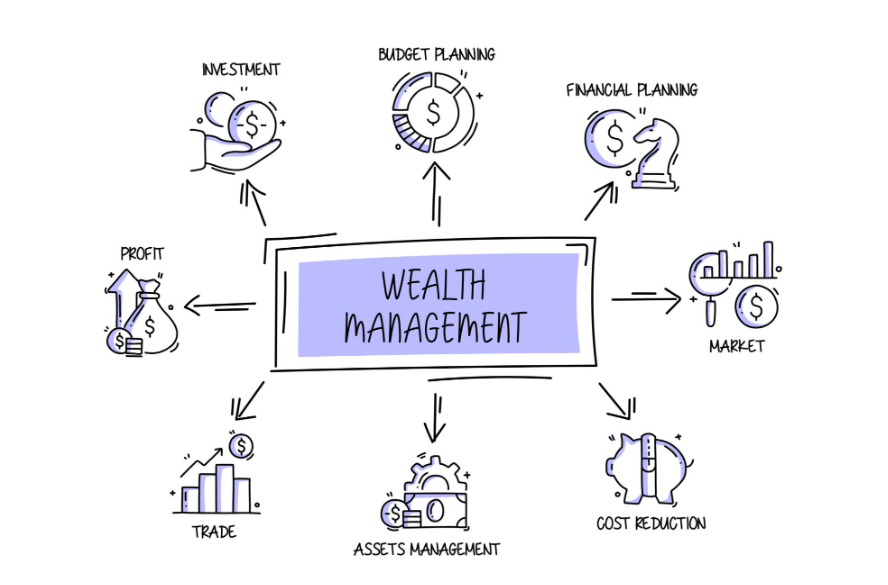
Tracking cash flow prevents “lifestyle creep”—the tendency to increase spending in direct proportion to income raises.
A practical system like the 50/30/20 Rule provides structure without micromanagement:
| Category | Allocation | Examples |
| Needs | 50% | Rent/Mortgage, Utilities, Basic Groceries, Transportation |
| Wants | 30% | Dining out, Entertainment, Hobbies, Vacations |
| Savings & Investments | 20% | Index Funds, Retirement Accounts, Debt Paydown beyond Minimums |
4. Eliminate High-Interest Consumer Debt
High-interest debt (like credit cards with 18–29% APR) acts as anti-compounding. It drains your net worth faster than typical investments can build it.
- The Strategy: Prioritize paying off any debt with an interest rate above 7% before expanding discretionary investments.
- Execution Method: Use the Debt Avalanche Method (paying off highest-interest accounts first to minimize total interest paid) or the Debt Snowball Method (paying off smallest balances first for psychological momentum).
5. Buy Income-Generating Assets, Not Liabilities
Wealthy individuals focus on accumulating assets that put money into their pockets, while avoiding liabilities that pull money out.
- Assets: Low-cost index funds, dividend-yielding equities, real estate, income-producing business equity, treasury securities.
- Liabilities: New luxury cars (rapid depreciation), high-end electronics, excessive subscription models, lifestyle upgrades financed on credit.
6. Build a High-Yield Emergency Buffer
Financial shocks—job loss, medical emergencies, home repairs—force unbuffered individuals to sell investments at a loss or take on high-interest debt.
- Target: Keep 3 to 6 months of essential living expenses in a liquid High-Yield Savings Account (HYSA).
- Result: Protects your long-term investment portfolio from panic selling during market drawdowns.
7. Invest in Your Earning Capacity & Financial Literacy
Your primary career or business is your highest-leverage engine for generating capital. Increasing your income creates a larger surplus to feed into compounding investments.
- Upskilling: Acquire high-income skills (technical expertise, negotiation, leadership, financial modeling).
- Knowledge Acquisition: Read personal finance books, follow market developments, and understand tax-advantaged accounts available in your jurisdiction (e.g., 401(k), IRA, ISA, or Provident Funds).
def compound_interest(P, PMT, r, t, n=12):
# P: principal
# PMT: monthly contribution
# r: annual interest rate decimal (e.g., 0.07)
# t: years
# n: compounding periods per year
rate_per_period = r / n
total_periods = n * t
future_value_principal = P * ((1 + rate_per_period) ** total_periods)
future_value_contributions = PMT * (((1 + rate_per_period) ** total_periods – 1) / rate_per_period)
return future_value_principal + future_value_contributions
Compound interest accelerates wealth building by generating returns on both your original deposit and your accumulated gains over time. When combined with recurring monthly contributions, the future portfolio value is modeled by:
- $P$: Initial starting principal
- $PMT$: Recurring monthly contribution
- $r$: Annual interest rate (as a decimal)
- $n$: Compounding frequency per year ($12$ for monthly compounding)
- $t$: Investment horizon in years
Adjust the parameters below to see how different contributions, interest rates, and timeframes impact your long-term growth.
Leave a Reply