

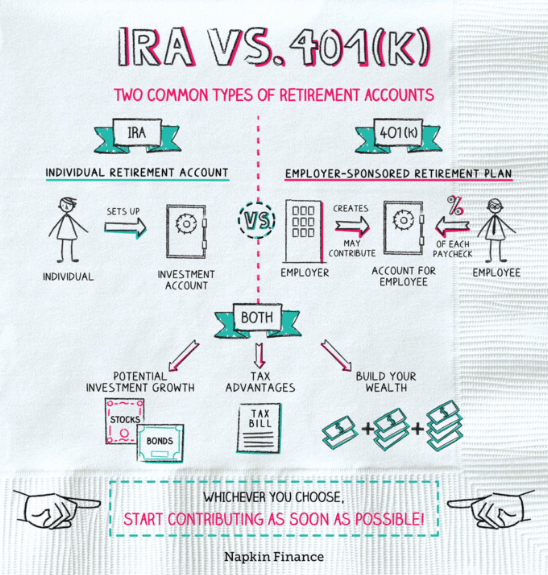
A 401(k) is an employer-sponsored retirement account tied to your job, while an IRA (Individual Retirement Account) is a personal account you set up independently through a brokerage firm (like Vanguard, Fidelity, or Schwab).
Both offer tax advantages to accelerate retirement savings, but they operate under completely different rules regarding contribution limits, employer matching, investment options, and tax treatment.

Core Structural Differences
| Feature | 401(k) Plan | Individual Retirement Account (IRA) |
| Account Type | Employer-sponsored workplace plan | Personal account opened by an individual |
| 2026 Contribution Limit | $24,500 per year (under 50) | $7,500 per year (under 50) |
| Catch-up Limit (Age 50+) | +$8,000 ($32,500 total) | +$1,100 ($8,600 total) |
| Employer Matching | Common (e.g., 50% match up to 6% of salary) | None (100% self-funded) |
| Investment Selection | Limited to plan’s designated menu (15–30 funds) | Virtually unlimited (Stocks, ETFs, Mutual Funds, Bonds) |
| Income Restrictions | No income limit to contribute | High earners face Roth limits & Traditional deduction caps |
| Early Withdrawal Loans | Often permits 401(k) loans up to $50,000 | Loans not permitted; withdrawals incur tax + 10% penalty |
How Income Flows Through Each Account

                                  ┌────────────────────────┐
                                  │   TOTAL EARNED INCOME  │
                                  └───────────┬────────────┘
                                              │
                      ┌───────────────────────┴───────────────────────┐
                      ▼                                               ▼
          ┌───────────────────────┐                       ┌───────────────────────┐
          │     401(k) PATH       │                       │       IRA PATH        │
          │  (Employer-Sponsored) │                       │  (Individual Account) │
          └───────────┬───────────┘                       └───────────┬───────────┘
                      │                                               │
             [Payroll Deduction]                             [Bank Transfer]
                      │                                               │
       ┌──────────────┴──────────────┐                 ┌──────────────┴──────────────┐
       ▼                             ▼                 ▼                             ▼
┌──────────────┐              ┌──────────────┐  ┌──────────────┐              ┌──────────────┐
│ Traditional  │              │  Roth 401(k) │  │ Traditional  │                Roth IRA
│    401(k)    │              │              │  │     IRA      │
├──────────────┤              ├──────────────┤  ├──────────────┤              ├──────────────┤
│ Pre-tax      │              │ Post-tax     │  │Tax deductible│              Post-tax     dollars        │              │ dollars      │  │(income limits)               dollars
│ Taxed at     │              │ Tax-FREE     │  │ Taxed at     │               Tax-FREE
│ withdrawal   │              │ withdrawal   │  │ withdrawal   │               withdrawal
└──────┬───────┘              └──────┬───────┘  └──────┬───────┘              └──────┬───────┘
       │                             │                 │                             │
       └──────────────┬──────────────┘                 └──────────────┬──────────────┘
                      ▼                                               ▼
         ┌────────────────────────┐                      ┌────────────────────────┐
         │ Restricted Menu:       │                      │ Full Market Access:    │
         │ Target-date funds,     │                      │ Individual stocks,     │
         │ select mutual funds    │                      │ index ETFs, REITs      │
         └────────────────────────┘                      └────────────────────────┘
Tax Structures: Traditional vs. Roth
Both 401(k)s and IRAs come in two primary tax favors:
- Traditional (Pre-Tax): Contributions reduce your taxable income in the year you make them. Money grows tax-deferred, and you pay ordinary income tax when you withdraw funds in retirement (after age $59\frac{1}{2}$).
- Roth (Post-Tax): Contributions are made with money you have already paid taxes on. Growth and future withdrawals in retirement are 100% tax-free.
Optimal Funding Strategy (The “Waterfall” Method)
If you have access to both accounts, structure your contributions in this order to maximize tax benefits and free money:
- 401(k) up to the Employer Match: Contribute enough to get 100% of any employer matching funds (e.g., matching up to 4% or 6%). This is an immediate guaranteed return.
- Max Out an IRA: Direct your next dollars into a Roth or Traditional IRA ($7,500 limit) to gain access to lower-fee index funds and broader investment choices.
- Return to Max Out the 401(k): If you still have surplus savings, contribute back to your 401(k) until you hit the $24,500 ceiling.
- Taxable Brokerage Account: Once tax-advantaged accounts are maxed out, invest remaining funds in a standard taxable account.
The “Immediate Return” of the Match
While both portfolios benefitted from the same hypothetical 7% market growth, the employer match provided a 100% immediate return on investment in Year 1 before the market even moved.
This meant the 401(k) account was compounding $10,000 of starting capital every single year instead of the IRA’s $5,000. As a result:
- Double the Final Balance: After 20 years, the matched 401(k) portfolio is exactly double the value of the self-funded IRA portfolio.
- Leverage: The employee in the 401(k) scenario only contributed $100,000 of their own money over 20 years, but ended with $438,652. They effectively leveraged an additional $100,000 of capital from their employer to generate an extra $119,326 in compound growth earnings.
Next post:How Scientists Are Searching for Habitable Planets

Leave a Reply