

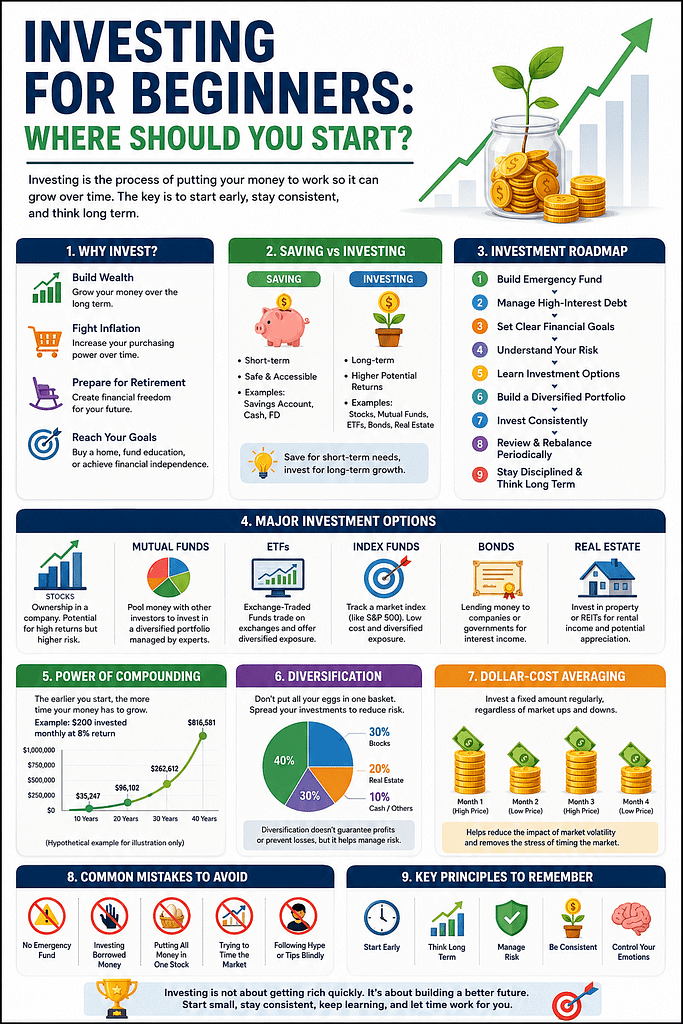
Investing for Beginners: Where Should You Start?
Investing can seem complicated when you are just getting started. You may hear people talking about stocks, mutual funds, ETFs, bonds, index funds, dividends, compound interest, and retirement accounts. With so many choices, it is natural to ask one simple question: Where should a beginner actually start?
The good news is that successful investing does not require you to be an expert, have a huge amount of money, or constantly watch the financial markets. The most important things are understanding the basics, setting clear goals, managing risk, and staying consistent for the long term.
This guide explains investing from the ground up. You will learn what investing is, why people invest, how much money you may need, which investment options beginners can consider, how to create a simple investment strategy, common mistakes to avoid, and how compound growth can potentially help build wealth over time.
What Is Investing?
Investing means putting money into an asset with the expectation that it may increase in value or generate income over time.
When you keep money in cash, its value generally remains the same in numerical terms. However, inflation can reduce what that money can buy in the future.
Investing gives your money an opportunity to grow.
For example, suppose you have $1,000. You could keep it in cash, or you could invest it in an asset that potentially earns returns over many years.
A simplified investment cycle looks like this:
             YOUR MONEY
                  │
                  ▼
        ┌─────────────────┐
        │    INVESTMENT   │
        │ Stocks / Funds  │
        │ Bonds / Other   │
        └────────┬────────┘
                 │
          Potential Return
                 │
                 ▼
        ┌─────────────────┐
        │ MORE MONEY OVER │
        │     TIME        │
        └────────┬────────┘
                 │
                 ▼
       Reinvest Your Returns
                 │
                 └──────────────► Growth
Investment returns are never guaranteed. Some investments can lose value, sometimes significantly. That is why understanding risk is one of the most important parts of becoming an investor.
Why Should You Invest?
There are several reasons people invest.
1. To Build Wealth
One of the biggest reasons to invest is to build wealth over the long term.
If your investments generate returns and you continue adding money, your portfolio may become significantly larger over many years.
2. To Fight Inflation
Inflation means that prices generally rise over time.
If inflation averages 3% per year, for example, the same amount of money may buy fewer goods and services in the future.
Investing can potentially help your money grow faster than inflation, although there is no guarantee.
3. To Prepare for Retirement
Many people invest because they want financial independence later in life.
Starting earlier gives your investments more time to potentially grow.
4. To Reach Financial Goals
Investing can also be connected to specific goals, such as:
- Buying a home
- Building retirement savings
- Paying for education
- Creating a business fund
- Building long-term wealth
- Reaching financial independence
Your investment strategy should depend heavily on the goal you are trying to achieve.
Saving vs. Investing
Saving and investing are both important, but they serve different purposes.
Saving
Saving generally means keeping money in relatively safe and accessible places for short-term needs.
Examples include:
- Bank savings accounts
- Cash
- Short-term deposits
Investing
Investing involves putting money into assets that may fluctuate in value.
Examples include:
- Stocks
- Bonds
- Mutual funds
- ETFs
- Index funds
- Real estate
A simple way to think about the difference is:
              MONEY
                │
        ┌───────┴────────┐
        │                │
        ▼                ▼
      SAVING          INVESTING
        │                │
        ▼                ▼
 Short-term needs   Long-term growth
 Emergency fund     Wealth building
 Lower risk         Higher potential risk
A beginner should generally avoid investing money that will be needed very soon.
Step 1: Build an Emergency Fund First
Before investing aggressively, consider creating an emergency fund.
An emergency fund is money kept aside for unexpected expenses such as:
- Medical bills
- Job loss
- Emergency repairs
- Unexpected travel
- Urgent family expenses
The exact amount depends on your circumstances, income stability, and expenses. Many people aim for several months of essential expenses.
For example, if your essential monthly expenses are $2,000 and you want six months of emergency savings:
$2,000 × 6 = $12,000
That $12,000 would be your target emergency fund.
The important principle is simple:
Do not invest money that you may suddenly need to use for an emergency.
Step 2: Pay Attention to High-Interest Debt
Before investing heavily, look at your existing debt.
High-interest debt can make wealth building difficult because the interest you pay may be greater than the return you reasonably expect from an investment.
For example, imagine you have a credit card balance with a very high interest rate while expecting your investment portfolio to generate a lower average return over the long term.
In that situation, paying down the expensive debt may be a priority.
This does not mean every debt must be eliminated before investing. Low-interest debt and high-interest debt are very different.
The key is to understand:
Debt interest + investment return + risk = your overall financial picture.
Step 3: Define Your Investment Goal
Never invest simply because everyone else is investing.
First ask:
Why am I investing?
Your answer could be:
- Retirement
- Buying a house
- Education
- Financial independence
- Long-term wealth
- Another specific goal
Your goal determines your investment time horizon.
For example:
| Goal | Possible Time Horizon |
|---|---|
| Emergency expenses | Immediate |
| Vacation | 1–2 years |
| Home purchase | 3–7 years |
| Education | Several years |
| Retirement | 10+ years |
| Long-term wealth | 10–30+ years |
The longer your investment horizon, the more time you may have to recover from temporary market declines.
Step 4: Understand Risk
Risk is one of the most important concepts in investing.
Generally, investments with greater potential returns can also involve greater risk.
For example, individual stocks can experience large price movements. A diversified portfolio may reduce some company-specific risk, but it cannot eliminate market risk.
Think of risk like this:
                                        Potential Risk
     ▲
     │
     │        Individual Stocks
     │
     │      Stock Funds / ETFs
     │
     │    Balanced Funds
     │
     │   Bonds
     │
     │ Cash / Savings
     └────────────────────────►
          Potential Growth
This is only a simplified illustration. Actual risk varies significantly among individual investments.
A good investment strategy should match your ability and willingness to handle losses.
Step 5: Learn the Major Investment Types
Before putting money into anything, understand what you are buying.
Stocks
A stock represents ownership in a company.
If you buy shares of a public company, you become a shareholder.
Stocks can potentially provide returns through:
- Price appreciation
- Dividends
However, stock prices can rise and fall significantly.
For beginners, buying individual companies requires research because the performance of one company can be very different from the overall market.
Mutual Funds
A mutual fund pools money from many investors and uses that money to purchase a collection of investments.
Instead of buying 50 individual stocks yourself, you could potentially own a mutual fund that invests in many companies.
This can make diversification easier.
Exchange-Traded Funds
ETFs, or exchange-traded funds, are investment funds that trade on exchanges.
Many ETFs hold a collection of stocks, bonds, or other assets.
One of the major advantages of diversified ETFs is that they can provide exposure to many investments through a single fund.
However, not all ETFs are equally diversified or equally suitable for every investor.
Index Funds
An index fund attempts to track a particular market index.
For example, a fund may attempt to track a broad stock-market index.
Instead of trying to identify the next winning company, an index strategy can provide broad market exposure.
This is one reason index investing is frequently discussed as a simple approach for long-term investors.
Bonds
Bonds are debt investments.
When you buy a bond, you are generally lending money to an issuer in exchange for interest payments and repayment of principal according to the bond’s terms.
Bonds can play an important role in diversified portfolios, particularly for investors who want to reduce the portfolio’s dependence on stocks.
However, bonds are not completely risk-free. Bond prices can change, and issuers can potentially fail to make payments.
Real Estate
Real estate is another possible investment category.
People can invest directly by purchasing property or indirectly through certain investment vehicles.
Real estate can generate rental income and may appreciate in value, but it also involves costs, maintenance, taxes, financing considerations, and market risk.
It is not automatically safer than stocks.
Step 6: Understand Diversification
One of the most useful investing concepts for beginners is diversification.
Diversification means spreading your money across different investments rather than putting everything into one asset.
Imagine you have $10,000 and invest the entire amount in one company.
If that company experiences a serious problem, your portfolio could suffer dramatically.
Now imagine the money is spread across hundreds or thousands of companies through a diversified investment fund.
One company’s poor performance may have a smaller impact on your overall portfolio.
A simplified diversification diagram:
                 $10,000
                    │
          ┌─────────┼─────────┐
          │         │         │
          ▼         ▼         ▼
        Stocks    Bonds     Other
          │         │         │
       ┌──┼──┐      │      ┌──┼──┐
       ▼  ▼  ▼      ▼      ▼  ▼  ▼
      A   B   C    Bonds   D   E   F

        DIFFERENT ASSETS
               │
               ▼
        LOWER CONCENTRATION
        OF SINGLE-ASSET RISK
Diversification does not guarantee profits or prevent losses, but it can reduce the risk associated with depending too heavily on one investment.
Step 7: Understand Compound Growth
Compound growth is one of the most powerful ideas in long-term investing.
Compounding happens when your investment earns returns and those returns remain invested, allowing future returns to potentially build on previous returns.
For example, imagine you invest $1,000 and receive a hypothetical 8% annual return.
After one year:
$1,000 × 1.08 = $1,080
If the entire amount remains invested, another 8% return would be calculated on $1,080 rather than the original $1,000.
After another year:
$1,080 × 1.08 = $1,166.40
Over many years, this process can become increasingly powerful.
A simplified diagram:
These numbers are hypothetical and do not represent a guaranteed investment return.
The biggest advantage is often time.
Step 8: Start Small
Many beginners believe they need thousands of dollars before they can start investing.
That is not necessarily true.
Depending on the investment platform and country, investors may be able to start with relatively small amounts.
The important thing is developing a sustainable habit.
For example, someone might invest a fixed amount every month rather than trying to find the perfect day to invest.
Suppose an investor contributes $200 per month.
After one year:
$200 × 12 = $2,400
After five years:
$200 × 60 = $12,000
That is before considering any investment returns.
Consistency can matter more than making a huge initial investment.
Step 9: Consider Dollar-Cost Averaging
Dollar-cost averaging means investing a fixed amount at regular intervals.
For example:
January       $200
February      $200
March         $200
April         $200
May           $200
June          $200
July          $200
August        $200
September     $200
October       $200
November      $200
December      $200
              │
              ▼
       Regular Investing
When prices are lower, the same amount of money buys more shares.
When prices are higher, the same amount buys fewer shares.
This approach can reduce the pressure of trying to predict exactly when the market will rise or fall.
However, dollar-cost averaging does not guarantee better returns than investing a lump sum immediately when you already have the money available.
Step 10: Understand Investment Fees
Fees may seem small, but over long periods they can affect your results.
Common investment costs may include:
- Fund expense ratios
- Brokerage fees
- Account fees
- Transaction costs
- Advisory fees
- Taxes
Suppose two investments have similar performance but one has substantially higher ongoing costs.
Over many years, the difference can become meaningful.
Before investing, check the total cost of the investment.
Do not choose an investment solely because it has the lowest fee, but understand what you are paying for.
Step 11: Choose a Simple Portfolio
Beginners often make investing unnecessarily complicated.
They may buy dozens of stocks, frequently trade, follow financial influencers, and constantly change strategies.
A simpler approach can be easier to manage.
For example, a portfolio might contain:
             INVESTMENT PORTFOLIO
                     │
          ┌──────────┴──────────┐
          │                     │
          ▼                     ▼
     Stock Funds             Bonds
          │                     │
          ▼                     ▼
   Long-term Growth       Stability / Income
The exact allocation depends on factors such as
- Age
- Investment goal
- Time horizon
- Income
- Risk tolerance
- Financial situation
- Need for liquidity
There is no single portfolio that is perfect for everyone.
Step 12: Understand Asset Allocation
Asset allocation means deciding how much of your portfolio goes into different asset classes.
For example, a hypothetical portfolio might contain:
- 70% stocks
- 30% bonds
Another investor might choose a different allocation.
A younger investor with a long time horizon may be comfortable with greater exposure to stocks, while someone approaching a major financial goal may prefer a more conservative allocation.
However, age alone should not determine your portfolio.
Your personal financial situation matters.
Step 13: Avoid Trying to Time the Market
Market timing means attempting to predict when prices will rise or fall and making investment decisions based on those predictions.
For example:
The problem is that nobody can reliably predict every market top and bottom.
Investors who sell after a decline may miss the eventual recovery.
A long-term strategy often focuses more on:
Time in the market rather than trying to perfectly time the market.
This does not mean you should blindly hold every investment forever. It means your investment decisions should be based on a strategy rather than short-term emotions.
Step 14: Control Your Emotions
Investing is not only a financial challenge. It is also a psychological challenge.
Markets can become exciting when prices rise.
They can become frightening when prices fall.
This can lead investors to make emotional decisions.
A common cycle looks like this:
Prices Rise
    │
    ▼
Excitement
    │
    ▼
More Buying
    │
    ▼
Prices Become Expensive
    │
    ▼
Market Falls
    │
    ▼
Fear
    │
    ▼
Panic Selling
    │
    ▼
Potential Loss
A disciplined investor tries to avoid making major decisions purely because of fear or excitement.
Step 15: Reinvest Your Dividends
Some investments pay dividends.
Instead of taking dividends as cash, investors may have the option to reinvest them.
Reinvesting dividends can increase the number of shares you own.
Those additional shares may then potentially generate additional dividends in the future.
This can contribute to the compounding process.
However, dividends are not free money. A company’s share price and financial condition still matter.
Step 16: Learn Before Buying Individual Stocks
Buying individual stocks can be interesting, but beginners should understand the company before investing.
Research areas can include:
- Revenue
- Profits
- Debt
- Cash flow
- Competitive position
- Industry
- Management
- Valuation
- Future growth opportunities
- Major risks
Do not buy a stock simply because:
- It is trending online
- Someone on social media recommended it
- A celebrity mentioned it
- The price recently increased
- Someone claims it will “10X”
A popular investment is not automatically a good investment.
Step 17: Beware of Investment Scams
The internet has made investing easier, but it has also created more opportunities for scams.
Be especially careful with promises such as:
- “Guaranteed 20% monthly returns”
- “No-risk investment”
- “Double your money quickly.”
- “Secret trading strategy”
- “Guaranteed cryptocurrency profits”
- “Limited-time investment opportunity”
Legitimate investments involve risk.
If someone promises extremely high returns with little or no risk, that should be a major warning sign.
Never send money to an investment opportunity you do not understand.
Common Investing Mistakes Beginners Make
Mistake 1: Investing Without an Emergency Fund
If an emergency occurs, you may be forced to sell investments at an unfavorable time.
Mistake 2: Investing Borrowed Money
Borrowing money to invest can significantly increase risk.
Mistake 3: Putting Everything Into One Stock
Even a successful company can face unexpected problems.
Mistake 4: Constantly Trading
Frequent trading can increase costs, taxes, and emotional stress.
Mistake 5: Following Social Media Tips Blindly
Online investment content can be educational, but it can also be biased or misleading.
Mistake 6: Ignoring Fees
Small annual costs can compound over decades.
Mistake 7: Panic Selling
A temporary market decline does not automatically mean your long-term investment strategy has failed.
Mistake 8: Expecting Quick Wealth
Investing is generally a long-term process.
A Simple Beginner Investment Roadmap
If you are starting from zero, consider the following framework:
START
  │
  ▼
Understand Your Finances
  │
  ▼
Create Emergency Savings
  │
  ▼
Manage High-Interest Debt
  │
  ▼
Define Investment Goals
  │
  ▼
Choose Time Horizon
  │
  ▼
Understand Risk
  │
  ▼
Learn Investment Types
  │
  ▼
Build a Diversified Portfolio
  │
  ▼
Invest Consistently
  │
  ▼
Review Periodically
  │
  ▼
Stay Disciplined
  │
  ▼
LONG-TERM WEALTH BUILDING
This is a general educational framework, not individualized financial advice.
How Much Should a Beginner Invest?
There is no universal amount.
The right amount depends on your income, expenses, debt, emergency savings, goals, and risk tolerance.
Instead of asking:
“What is the maximum amount I can invest?”
Consider asking:
“What amount can I invest consistently without damaging my financial stability?”
For one person, that might be $50 per month.
For another, it might be $500 or more.
The important thing is that your investment contribution fits comfortably within your budget.
Example of a Beginner’s Monthly Budget
Imagine someone earns $3,000 per month.
A simplified budget could look like this:
                                Monthly Income: $3,000
        │
        ├── Essential Expenses
        │
        ├── Emergency Savings
        │
        ├── Debt Payments
        │
        ├── Investments
        │
        └── Lifestyle / Other Expenses
The actual percentages should depend on the individual’s circumstances.
There is no universal “perfect” budget.
The goal is to create a system where saving and investing happen consistently.
Investing for the Long Term
Long-term investing is fundamentally different from short-term speculation.
A long-term investor may think in terms of:
- 10 years
- 20 years
- 30 years
A short-term trader may think in terms of:
- Minutes
- Hours
- Days
- Weeks
These are different activities with different risks.
Beginners should understand the difference before deciding what strategy to follow.
What Should a Beginner Invest In?
There is no single answer.
For many beginners, diversified investment funds can be easier to understand and manage than selecting individual companies.
Broad-market index funds and diversified ETFs are commonly discussed because they can provide exposure to many securities through one investment.
However, suitability depends on your country, available investment products, taxes, fees, financial goals, and risk tolerance.
Before purchasing any investment, read the fund’s documents and understand what it owns.
A Beginner’s Investing Checklist
Before investing, ask yourself:
- Do I have emergency savings?
- Have I reviewed my high-interest debt?
- Do I know why I am investing?
- What is my investment time horizon?
- How much risk can I tolerate?
- Do I understand what I am buying?
- Is my portfolio diversified?
- Have I checked the fees?
- Am I investing money I can leave invested?
- Am I making decisions based on a plan rather than social media hype?
If you cannot explain why you own an investment, consider learning more before buying it.
The Power of Starting Early
One of the biggest advantages available to a beginner is time.
Consider two hypothetical investors.
Investor A starts investing at age 25.
Investor B waits until age 35.
Even if both investors eventually contribute significant amounts of money, Investor A has an additional decade for potential investment growth and compounding.
This is why starting early can be powerful.
You do not need to begin with a large amount.
You need to begin with an amount you can realistically maintain.
Final Thoughts
Investing does not need to be complicated.
The most important first steps are not finding the next hot stock or predicting tomorrow’s market movement.
Instead, focus on building a strong financial foundation.
Start by understanding your income and expenses. Build emergency savings. Manage expensive debt. Define your financial goals. Learn how different investments work. Understand risk. Diversify your portfolio. Keep investment costs under control. Invest consistently and give your money time to potentially grow.
Remember that investing involves risk. The value of investments can go down as well as up, and past performance does not guarantee future results.
The goal should not be to become rich overnight.
The goal is to develop a disciplined financial system that can potentially help you build wealth over many years.
The investing journey can be summarized in one simple diagram:
       FINANCIAL FOUNDATION
                │
                ▼
        Emergency Savings
                │
                ▼
       Manage Expensive Debt
                │
                ▼
          Set Clear Goals
                │
                ▼
        Understand Your Risk
                │
                ▼
          Diversify Assets
                │
                ▼
       Invest Consistently
                │
                ▼
       Reinvest & Compound
                │
                ▼
          Stay Disciplined
                │
                ▼
       LONG-TERM WEALTH
The best time to learn about investing is before you invest. The next best step is to create a simple plan that you understand and can follow consistently.
Start small. Stay informed. Diversify. Think long term. And never invest money in something you do not understand.
Leave a Reply