

HSA vs. FSA: Key Differences You Need to Know
If you have access to an employer-sponsored health benefits plan in the United States, you may have heard the terms HSA and FSA. Both accounts can help you pay for eligible healthcare expenses using money that receives favorable tax treatment, but they work very differently.
Understanding the difference between an HSA and an FSA is important because choosing the right account can affect how much you save on healthcare costs, whether your money can stay with you if you change jobs, and whether unused funds can continue growing over time.
At first glance, the two accounts may look similar. Both can be used for qualified medical expenses, and both can provide tax advantages. But eligibility rules, contribution limits, ownership, rollover rules, investment opportunities, and portability are different.
So, which one is better?
The answer depends on your health insurance plan, financial situation, and how you expect to use the money.
This guide explains HSA vs. FSA in simple terms and highlights the key differences beginners should understand.
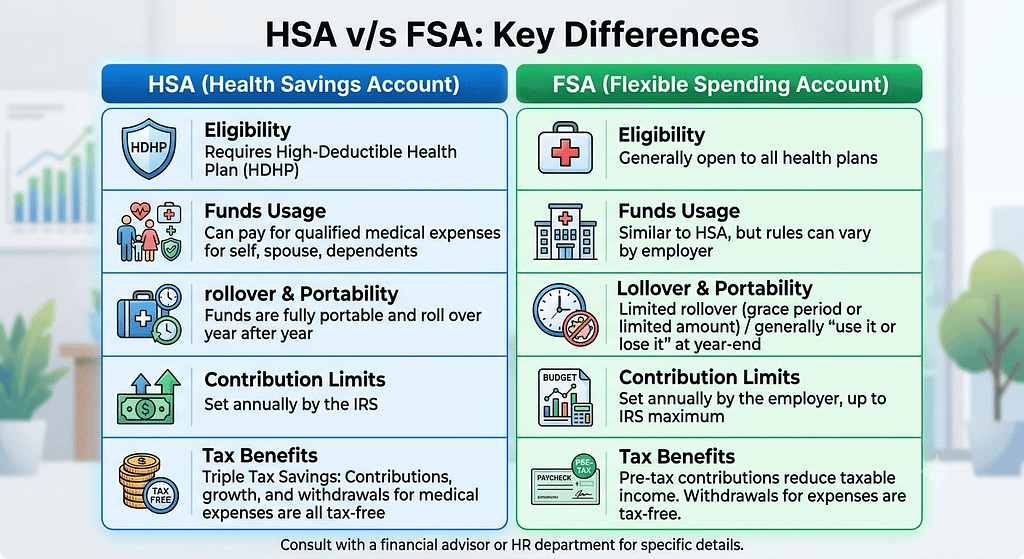
What Is an HSA?
HSA stands for Health Savings Account.
An HSA is a tax-advantaged account designed to help eligible individuals save money for qualified medical expenses.
The important word is eligible.
Generally, to contribute to an HSA, you must be covered by an HSA-eligible high-deductible health plan (HDHP) and meet other IRS requirements.
An HSA can be useful because it combines healthcare spending with long-term savings potential.
Depending on the account and provider, you may be able to keep money in the HSA, use it for eligible medical expenses, and potentially invest part of the balance.
One of the biggest advantages of an HSA is that the account generally belongs to you, rather than being tied permanently to one employer.
What Is an FSA?
FSA stands for Flexible Spending Account.
An FSA is generally an employer-sponsored benefit that allows employees to set aside part of their compensation for eligible healthcare expenses.
The money can then be used for qualified expenses according to the rules of the plan and applicable tax regulations.
Unlike an HSA, an FSA is generally connected to your employer’s benefits program.
That means changing jobs can affect what happens to your account.
FSAs can still be extremely useful, particularly when you know that you will have eligible medical expenses during the year.
HSA vs. FSA: Quick Comparison
Here is a simplified comparison:
| Feature | HSA | FSA |
|---|---|---|
| Full name | Health Savings Account | Flexible Spending Account |
| Eligibility | Generally requires an HSA-eligible HDHP and other requirements | Generally offered through an employer |
| Account ownership | Generally belongs to the individual | Generally part of an employer benefit plan |
| Employer required? | No, although employers may contribute | Usually yes |
| Contributions | Employee and/or employer | Employee and/or employer |
| Rollover | Generally yes | Generally limited, depending on plan rules |
| Investment option | May be available | Generally no |
| Portability | Generally portable | Usually tied to employment |
| Best suited for | Healthcare spending and potentially long-term savings | Planned eligible healthcare expenses |
The exact rules depend on IRS requirements and your specific plan.
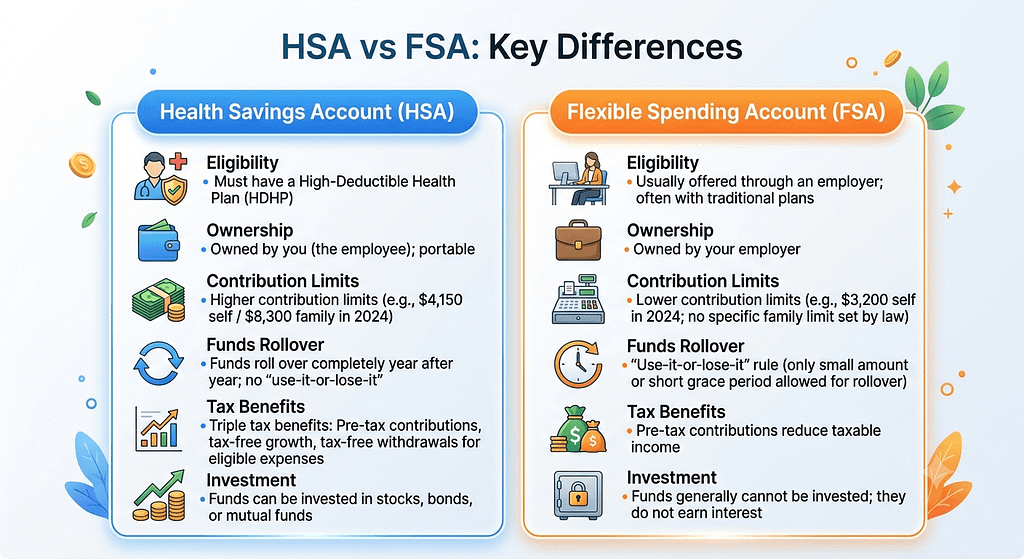
1. Eligibility: HSA vs. FSA
One of the biggest differences is eligibility.
HSA Eligibility
To contribute to an HSA, you generally need to meet specific requirements.
A major requirement is having qualifying coverage under an HSA-eligible high-deductible health plan.
There are also other eligibility rules.
For example, certain other types of health coverage can affect whether you can contribute.
This means you should not assume that every high-deductible insurance plan automatically qualifies.
Always check whether your health plan is specifically HSA-eligible.
FSA Eligibility
FSAs are generally offered through employers.
If your employer provides an FSA as part of its benefits package, you may be able to participate according to the plan’s rules.
You generally do not need an HSA-eligible high-deductible health plan to use a healthcare FSA.
This makes FSAs available to many employees who cannot contribute to an HSA.
2. Who Owns the Account?
This is another major difference.
An HSA generally belongs to you.
If you change employers, the HSA typically remains yours.
Your money does not normally disappear simply because you leave your job.
An FSA, on the other hand, is generally established through an employer’s benefits plan.
Because of this, your FSA can be affected when your employment ends.
There may be special continuation or limited circumstances under which you can continue using or accessing FSA funds, but the rules are different from an HSA.
This is one reason HSAs can be attractive for people who want a healthcare account that can remain with them throughout their careers.
3. What Happens to Unused Money?
This is one of the most important HSA vs. FSA differences.
HSA: Generally Rolls Over
Money left in an HSA generally remains in the account and can be used in future years.
There is generally no “use it or lose it” rule for HSAs.
For example, imagine you contribute $3,000 but only use $1,500 for eligible healthcare expenses.
The remaining $1,500 generally stays in your HSA.
It can potentially continue to grow.
FSA: Generally Has a Use-It-or-Lose-It Structure
FSAs traditionally operate under a use-it-or-lose-it concept.
However, an employer plan may offer certain options allowed under the rules, such as a limited carryover or a grace period.
The amount that can be carried over can change from year to year, so you should check the current rules and your employer’s plan.
This makes planning particularly important with an FSA.
If you contribute too much and do not have enough eligible expenses, you may not be able to keep all of the unused amount.
4. HSA Money Can Potentially Be Invested
Another major advantage of an HSA is that some HSA providers allow account holders to invest part of their balance.
Depending on the provider, investment choices may include mutual funds or other investment options.
This means an HSA can potentially serve two purposes:
Short-term healthcare spending + long-term healthcare savings.
For example:
                HSA
                 │
        ┌────────┴────────┐
        │                 │
        ▼                 ▼
   Medical Cash       Investments
        │                 │
        ▼                 ▼
 Current Expenses    Long-Term Growth
Not every HSA offers the same investment options, and investment returns are not guaranteed.
An FSA generally does not work this way. It is primarily designed as a spending account for eligible expenses rather than a long-term investment account.
5. Tax Advantages
Both HSAs and FSAs can offer significant tax advantages, although the exact tax treatment depends on the circumstances and applicable rules.
HSA Tax Advantages
An HSA is often described as having a triple tax advantage:
- Eligible contributions can generally be made on a pre-tax basis or may be deductible depending on how the contribution is made.
- Investment growth inside the HSA is generally not taxed while it remains in the account.
- Withdrawals used for qualified medical expenses are generally tax-free.
This combination makes HSAs particularly interesting for long-term healthcare planning.
FSA Tax Advantages
FSA contributions are generally made on a pre-tax basis through an employer’s cafeteria plan.
Using pre-tax money for eligible healthcare expenses can reduce taxable income and potentially lower the amount of federal income and payroll taxes owed.
The tax benefits are one reason these accounts can be valuable even when the amounts involved are relatively small.
6. Contribution Limits
Both HSAs and FSAs have annual contribution limits established under applicable rules.
These limits can change over time.
For HSA contributions, the annual limit depends on whether you have self-only or family coverage.
There are also special rules for certain older individuals who may qualify for catch-up contributions.
FSA limits are generally different and are subject to annual adjustments.
Your employer may also set plan-specific rules within the limits permitted by law.
Because contribution limits change, do not rely on an old article or outdated social media post when deciding how much to contribute.
Check the current IRS limits and your employer’s benefits information for the relevant tax year.
7. How Medical Expenses Work
Both accounts can generally be used for qualified medical expenses.
Examples may include eligible costs such as:
- Doctor visits
- Prescription medications
- Certain medical treatments
- Dental expenses
- Vision expenses
- Certain medical equipment
- Other eligible healthcare costs
However, not every healthcare expense automatically qualifies.
Before using HSA or FSA money, verify whether the expense is eligible under the applicable rules.
Keep your receipts and supporting records.
Good recordkeeping is especially important because you may need documentation to demonstrate that a withdrawal was for a qualified expense.
8. What Happens If You Change Jobs?
This is where the difference between HSA and FSA becomes particularly important.
HSA
Your HSA generally stays with you when you change jobs.
You can typically continue using the account for qualified medical expenses even if your new employer does not offer an HSA.
The account is yours.
FSA
An FSA is generally connected to your employer’s benefits plan.
When you leave the company, your ability to use the account can change.
Depending on the circumstances and plan rules, you may have limited access to remaining funds or continuation rights.
This is one reason employees should understand their employer’s FSA rules before leaving a job.
9. HSA vs. FSA for Long-Term Savings
If your goal is simply to pay expected healthcare expenses during the year, an FSA can be useful.
But if you are thinking about healthcare expenses over decades, an HSA has some unique advantages.
Because HSA balances can generally roll over from year to year and may be invested, an HSA can potentially become a long-term healthcare savings vehicle.
Imagine contributing consistently over many years while paying current healthcare expenses from another source when financially practical.
The HSA could potentially remain invested and grow over time.
However, this strategy requires sufficient cash flow and should not come at the expense of necessary current healthcare spending or other financial priorities.
Example: HSA vs. FSA
Imagine two employees, Sarah and David.
Sarah has an HSA-eligible health plan and contributes money to an HSA.
David has an employer-sponsored FSA.
During the year, both expect to have $1,500 in eligible medical expenses.
Both accounts can potentially help them pay those expenses using tax-advantaged money.
But there is an important difference.
Sarah’s unused HSA balance generally stays with her.
David’s FSA balance is subject to the employer plan’s rules regarding carryover, grace periods, and unused funds.
If Sarah changes jobs, her HSA generally remains hers.
David’s FSA situation may change when he leaves his employer.
This illustrates why the two accounts can look similar but behave very differently.
Which Is Better: HSA or FSA?
There is no universal winner.
Your circumstances determine which account is more useful.
An HSA May Be Attractive If:
- You are eligible to contribute.
- You have an HSA-eligible health plan.
- You want money to roll over from year to year.
- You want a portable healthcare account.
- You are interested in potentially investing healthcare savings.
- You are comfortable managing a higher-deductible health plan.
An FSA May Be Attractive If:
- Your employer offers an FSA.
- You are not eligible for an HSA.
- You expect predictable eligible healthcare expenses.
- You want to use pre-tax money for qualified expenses.
- You prefer an account designed primarily for current-year healthcare spending.
Can You Have an HSA and FSA at the Same Time?
This is an area where you should be careful.
Not every type of FSA is compatible with HSA contributions.
A general-purpose healthcare FSA can generally make you ineligible to contribute to an HSA because it provides additional coverage for medical expenses.
However, certain limited-purpose or post-deductible arrangements may be compatible with an HSA.
Because the rules are technical, do not assume that you can contribute to both accounts simply because your employer offers both.
Check the exact type of FSA and your HSA eligibility before contributing.
Common Mistakes to Avoid
Mistake 1: Assuming Every High-Deductible Plan Is HSA Eligible
Check the plan’s actual HSA eligibility.
Mistake 2: Forgetting FSA Deadlines
Know your plan’s deadline for spending funds or submitting claims.
Mistake 3: Contributing Without Checking Eligibility
HSA eligibility has specific requirements.
Mistake 4: Ignoring Investment Options
If you have an HSA and want to use it for long-term savings, understand whether your provider offers investment options and what fees apply.
Mistake 5: Spending HSA Money on Nonqualified Expenses
Certain nonqualified HSA withdrawals can result in taxes and potentially additional penalties depending on the circumstances.
Mistake 6: Failing to Keep Receipts
Keep records of eligible healthcare expenses and distributions.
Mistake 7: Choosing an Account Without Considering Your Health Plan
Your insurance plan and expected healthcare costs should be part of the decision.
HSA vs. FSA: A Simple Decision Framework
You can think about the decision this way:
              START
                │
                ▼
       Is an HSA available to you?
             /       \
           YES        NO
            │          │
            ▼          ▼
    Is your health     Consider
    plan HSA-eligible? an FSA if
       /       \       available
     YES        NO
      │          │
      ▼          ▼
    HSA       FSA may be
    may be    an option
    suitable
      │
      ▼
  Compare costs,
  tax benefits,
  rollover rules
  and your goals
This is only a general framework. Your actual decision should be based on your health plan, eligibility, expected expenses, tax situation, and financial goals.
Final Thoughts
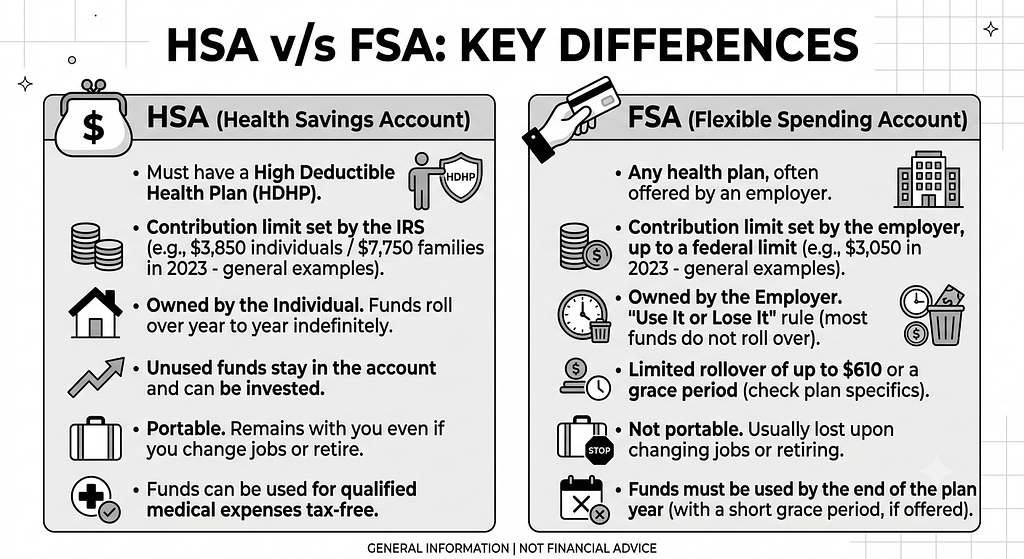
HSA and FSA accounts can both help make healthcare expenses more manageable, but they are not interchangeable.
The HSA generally stands out for its portability, rollover feature, and potential investment capability. For someone who qualifies and wants to build long-term healthcare savings, these features can make an HSA particularly valuable.
The FSA can be useful for employees who expect eligible healthcare expenses and want to use pre-tax money to help pay those costs. However, because FSA funds are generally subject to employer plan rules regarding unused balances, careful planning is important.
The biggest lesson is that you should not choose an HSA or FSA simply because one sounds better.
Look at the whole picture:
Health plan → Eligibility → Expected expenses → Tax benefits → Rollover rules → Portability → Long-term goals.
Once you understand these differences, it becomes much easier to decide which healthcare savings option may fit your financial situation.
And remember: healthcare accounts are only one part of a broader financial plan. Emergency savings, retirement investing, insurance, debt management, and everyday budgeting all matter too.
Leave a Reply