

Building long-term financial independence requires a systematic approach anchored in proven economic principles. Whether you are aiming to build wealth on a low salary or simply looking for fundamental financial laws to guide your money management, sustainable wealth comes down to controlling cash flow, leveraging compounding, and protecting your capital.

Diagram Explanation & Description
The diagram illustrates the life-cycle model of wealth accumulation, mapping how capital typically grows over a person’s working lifetime:
The Fundamental Equation of Wealth
Every strategy for building wealth relies on one fundamental formula:
- $\text{Net Surplus}$: The cash remaining at the end of each period to allocate toward assets.
- $r$: The net rate of return on invested assets after accounting for fees and inflation.
- $t$: The total time horizon in years.
Core Pillars for Sustainable Growth
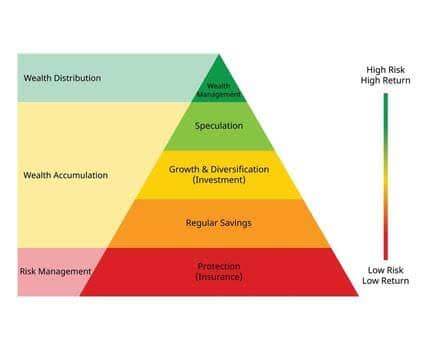
The Financial Planning Pyramid illustrates how capital allocation must be prioritized to ensure stability before pursuing higher returns
Base Tier (Risk Management / Protection): The absolute foundation of personal finance. Before investing for growth, capital must be secured in emergency funds and health/life insurance. Without this layer
Strategic Frameworks for Execution
Expanding your net surplus and protecting capital requires structured asset allocation models tailored to your specific financial phase.
1. Asset Allocation by Risk Horizon
How you split your investable surplus depends on your investment time horizon:
| Horizon | Primary Focus | Recommended Asset Classes | Target Return Strategy |
| Short-Term (<3 Years) | Capital Preservation | High-Yield Savings, Treasury Bills, Liquid Debt Funds | Matches Inflation |
| Medium-Term (3–7 Years) | Balanced Growth | Balanced Advantage Funds, High-Grade Corporate Debt, Dividend Stocks | Moderate Real Growth |
| Long-Term (7+ Years) | Maximum Compounding | Broad Market Equity Index Funds, Global ETFs, Real Estate | High Equity Risk Premium |
The Mechanics of the Savings Rate Gap
Increasing your savings rate impacts your timeline to financial independence far more than chasing higher market returns.
Impact of Savings Rate on Time to Retirement
Core Tactics for Optimization
Portfolio allocation involves distributing capital across different asset classes—primarily equities (stocks), fixed income (bonds), and cash or cash equivalents—to align with an investor’s goals, time horizon, and risk tolerance.
Below are example portfolio allocation models for Conservative, Moderate, and Aggressive risk profiles, along with breakdown details for each.
Conservative Model Portfolio
Asset Allocation Split:
Moderate Model Portfolio
Asset Allocation Split:
Aggressive Model Portfolio
Asset Allocation Split:
–
Next Post: How Compound Interest Can Grow Your Money

Leave a Reply