

Preparing for competitive exams requires a masterclass in handling Current Affairs (CA). It isn’t just about memorizing facts; it’s about building a framework that connects daily events to core syllabus topics. Whether you are aiming for Civil Services (UPSC), banking (IBPS, SBI), staff selection (SSC CGL), or state public service commissions, this comprehensive guide lays out a structural roadmap to master current affairs.
Decoding Current Affairs: Why it Dominates Exams
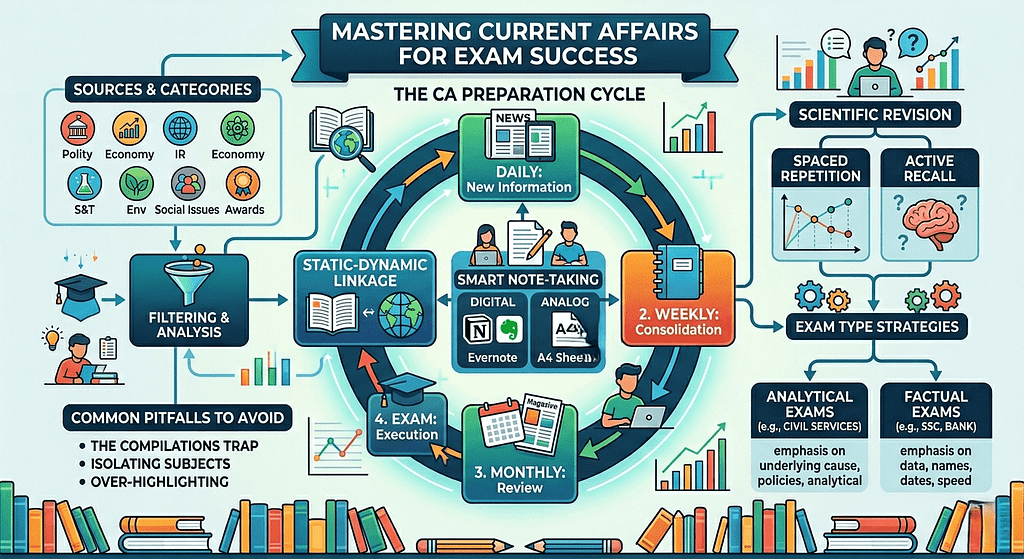
Examiners use current affairs to test an applicant’s awareness, analytical ability, and adaptability to real-world scenarios. In modern competitive exams, questions are rarely strictly static (from textbooks) or strictly dynamic (from the news). Instead, they exist in a hybrid state called “Static-Dynamic Linkage.”
The Static-Dynamic Linkage Principle: A current event acts as a trigger for the examiner to ask a question about a core conceptual principle.
For instance, if a major country faces an inflation crisis, the exam won’t just ask about that country’s inflation rate. It will test your baseline understanding of fiscal versus monetary policy, central banking mechanisms, or consumer price indices.
Categorizing the Vast Current Affairs Universe
To prevent information overload, separate current affairs into seven core operational buckets. This ensures balanced coverage across national and international developments.
| Category | Primary Focus Areas | High-Yield Exam Types |
| Polity & Governance | Constitutional amendments, landmark judicial verdicts, newly enacted bills, federal disputes, election reforms. | Civil Services, State PSCs, Law Entrances |
| Economy & Infrastructure | Central Bank updates, budget allocations, economic surveys, global trade pacts, banking regulations, inflation indices. | Banking, Insurance, UPSC, SSC CGL |
| International Relations | Bilateral agreements, global summits (G20, BRICS, ASEAN), geopolitical conflicts, global indices/rankings. | Defense Exams, UPSC, Diplomatic Services |
| Science & Technology | Space exploration missions, artificial intelligence breakthroughs, biotechnology, public health initiatives, defense tech. | SSC, Railways, State Services, UPSC |
| Environment & Ecology | Climate summits (COP), wildlife conservation, national parks, pollution control policies, renewable energy goals. | All major competitive exams |
| Social Issues & Schemes | Government welfare programs, gender parity, public health data, education reforms, poverty elimination initiatives. | State Public Services, Civil Services |
| Awards, Sports & Personages | Nobel prizes, major sporting events (Olympics, World Cups), appointments, historic obituaries. | SSC CGL, Banking, Railways, Defense |
Step-by-Step Methodology to Process News
1.Source Identification:Daily investment: 45–60 minutes. Select one standard, reliable national daily newspaper (e.g., The Hindu, The Indian Express, or The New York Times/Financial Times for international contexts). Stick to it. Do not read multiple newspapers daily; it leads to diminishing returns.
2.Filtering with Syllabus Filters:Daily execution. Before reading any article, look at it through your exam syllabus. If an article details local political mudslinging or a regional crime event, skip it. If it addresses a policy change, institutional reform, or structural economic shift, highlight it.
3.The 360-Degree Analysis (Core Processing):The analytical engine.
For every major news event, break it down using the 5W1H Framework: What happened? When? Where? Who is involved? Why did it occur? How does it impact the future? This builds a holistic mental map.
4.The Static-Dynamic Integration Bridge:Deepening context. Open your standard textbook or reference material when a news item breaks. If there is a dispute over a governor’s powers in the news, immediately read the constitutional chapters detailing gubernatorial authority and emergency powers.
Smart Note-Taking: Digital vs. Analog Foundations
The biggest trap in exam preparation is creating long, unmanageable notes that mirror the textbook. Your notes must be brief, dense, and built for rapid review.
Digital Note-Taking (Recommended for Dynamic Content)
Using tools like Evernote, OneNote, or Notion works well for current affairs because news updates are fluid. You can build a single page for a topic like “Artificial Intelligence Regulations” and continuously add bullet points as new laws roll out over months. Use tags corresponding to your syllabus buckets for easy sorting.
Analog Note-Taking (Loose Sheets)
If you prefer pen and paper, never use bound notebooks. Use loose white A4 sheets kept in ring binders. When a topic expands, you can easily insert a new sheet of paper into the middle of the binder without breaking the order of your notes.
The “One-Page, One-Issue” Rule
Limit your notes to a single page per major topic. Use bullet points, short acronyms, and clear arrows indicating cause and effect.
[Rising Global Temperatures] ──> [Glacial Melt] ──> [Sea Level Rise] ──> [Threat to Coastal Cities]
5. Balancing the Daily, Weekly, and Monthly Cycles
Trying to memorize everything daily is exhausting, while waiting until the end of the year causes panic. Divide your preparation into distinct cycles:
┌────────────────────────────────────────────────────────┐
- Daily: Read the newspaper and jot down critical data points (such as percentages, names, or bills). Don’t spend hours writing beautifully formatted essays every day.
- Weekly: Dedicate 2 hours on the weekend to review your daily pointers. Take a weekly current affairs quiz online to check your recall.
- Monthly: Read a high-quality monthly current affairs compilation magazine. This cross-references your daily self-made notes with curated overviews from experts, catching any blind spots you might have missed.
┌────────────────────────────────────────────────────────┐
│ DAILY COMPONENT │
│ • Newspaper Reading (45 mins) │
│ • Brief Pointer Notes (15 mins) │
└────────────────────────────────────────────────────────┘
▼ ▼
┌────────────────────────────────────────────────────────┐
│ WEEKLY COMPONENT │
│ • Review Daily Notes (1-2 hours) │
│ • Take Weekend Topical Quizzes │
└───────────────────────────── ───────────────────────────┘
▼ ▼
┌────────────────────────────────────────────────────────┐
│ MONTHLY COMPONENT │
│ • Read Consolidated Monthly Magazine │
│ • Consolidate and Fill Gaps in Notes │
└────────────────────────────────────────────────────────┘
6. Scientific Revision Techniques for Long-Term Retention
Our brains naturally forget information over time. To combat this, structure your revision around proven cognitive science principles.
Spaced Repetition Mechanics
Do not read a topic once and wait until the exam to review it. Review your notes using an escalating timeline:
$$\text{Initial Study (Day 0)} \longrightarrow \text{Review 1 (Day 1)} \longrightarrow \text{Review 2 (Day 7)} \longrightarrow \text{Review 3 (Day 30)}$$
This specific spacing pattern resets your forgetting curve, moving information from short-term memory into long-term storage.
Active Recall Exercises
Instead of passively re-reading highlighted text, cover your notes and ask yourself open-ended questions. “What were the three conditions outlined in that trade treaty?” Forcing your brain to retrieve the information strengthens neural pathways far better than simply looking over a page.
Customizing Your Approach by Exam Type
Different exams test current affairs through distinct lenses. Adjust your focus based on your target test.
Analytical and Concept-Heavy Exams (e.g., Civil Services, Management)
Focus: The underlying cause, policy implications, structural challenges, and systemic solutions.
Output Requirement: Writing descriptive, multi-dimensional answers or passing complex analytical multiple-choice questions (MCQs).
Strategy: Prioritize editorial pages and opinion columns.
Fact-Driven, Speed-Heavy Exams (e.g., SSC, Railways, State Single-Tier Exams)
Focus: Core data points, exact dates, names of dignitaries, championship winners, venue locations, and official titles.
Output Requirement: Rapid-fire elimination of options under tight time constraints.
Strategy: Focus on daily news summaries, factual one-liners, and speed quizzes.
Common Strategy Pitfalls and How to Avoid Them
Even dedicated students can fail to score well in current affairs due to a few common strategic errors.
The “Compilations” Trap: Skipping daily reading and relying entirely on end-of-year or end-of-month mega-booklets. Without daily context, memorizing hundreds of pages of raw bullet points right before an exam is incredibly difficult.
Treating Current Affairs like a Separate Subject: Current affairs is an extension of your existing subjects. If you treat it like an isolated topic, your understanding will remain shallow, and your answers will lack depth.
Over-Highlighting: Turning your newspaper or printed notes into a sea of neon colors without committing the core points to memory. Highlight no more than 10-15% of a text—only the essential hooks.
Final Action Blueprint for Success
To turn this strategy into a daily routine, start with these four steps tomorrow morning:
- Print your exact exam syllabus and tape it to your study desk.
- Pick one reliable newspaper and set a strict 60-minute timer for it each day.
- Set up a single notebook or digital workspace organized by the seven core buckets outlined above.
- End every day with a 10-question current affairs quiz to build a habit of active retrieval.
Consistent, deliberate daily effort beats frantic, last-minute cramming every single time. Treat current affairs as a daily window into how the world works, and the exam scores will follow naturally.


Leave a Reply