

1: Why do so many new traders lose money in their first month? Is it just bad luck?
No, it is rarely bad luck. 😎The primary reason beginners blow through their capital early on is a complete lack of a formalized trading 😂plan.
Many beginners trade based on “gut feelings,” social media tips, or breaking news headlines. They click “Buy” because a chart “looks like it’s ready to pop,” without defining any concrete parameters beforehand. This isn’t trading; it is gambling with extra steps. A professional trading plan is a structured business document that dictates your exact parameters before you ever risk a single rupee or dollar.
How to Avoid It: The Three-Question Rule
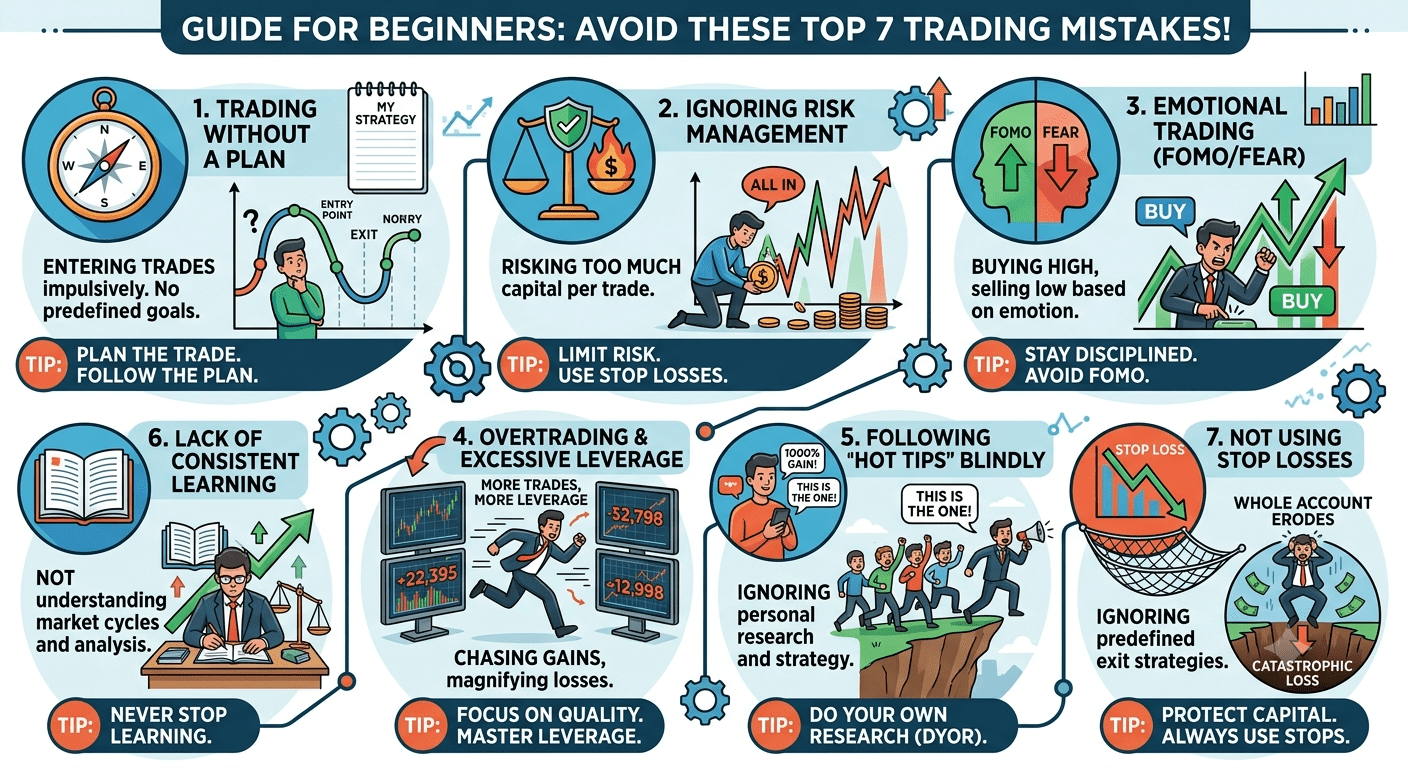
- Why am I entering? (What specific technical pattern, indicator crossover, or fundamental catalyst is triggering this entry?)
- Where am I wrong? (At what exact price point is my thesis invalidated, requiring me to exit with a small, controlled loss?)
- Where am I exiting with profit? (What is my target price based on historical support, resistance, or structural levels?)
If you cannot answer all three before executing the order, do not take the trade.
2: What is the single fastest way a beginner destroys their trading account?
The fastest path to absolute capital liquidation is trading without a hard Stop-Loss order, or worse, moving the stop-loss further away when a trade goes negative.
A stop-loss is an automated order placed with your broker to sell an asset when it reaches a specific price, designed to cap your maximum downside. Beginners often avoid setting stop-losses because they fear “getting stopped out” right before the market reverses in their favor. This psychological trap causes them to “hold and hope.”
When a trade drops below their entry, they tell themselves, “It will come back.” As it drops lower, the paper loss turns catastrophic. At that stage, fear turns into paralysis, and a trade that should have cost a tiny fraction of their portfolio ends up wiping out massive chunks of capital. ──► Market goes down…
ard Stops and Behavioral Discipline
- Never Use “Mental” Stops: Always input a hard, physical stop-loss order into your broker’s system the moment you execute an entry.
- The Golden Rule of Stops: You are allowed to move a stop-loss only in the direction of profitability (to lock in gains via a trailing stop). You must never move a stop-loss lower (in a long trade) or higher (in a short trade) to give a losing position “more room to breathe.” If your stop is hit, accept that your thesis was wrong, take the small exit, and move on.
3: Why does everyone talk about “Position Sizing”? How does a beginner figure out how much to buy?
Beginners often suffer from Oversizing Positions, which means investing too much of their total account capital into a single trade. If you have a ₹1,00,000 account and you buy ₹50,000 worth of a single highly volatile stock, a minor 10% adverse drop in that stock wipes out 5% of your entire portfolio. Two or three of these errors back-to-back leave you in a massive financial hole.
To fix this, professionals rely on Fixed Fractional Position Sizing. This mathematical model decouples the amount of money you risk from your raw emotional conviction about the trade.
How to Avoid It: The 1% Risk Formula
As a rule of thumb, a developing trader should never risk more than 1% to 2% of their total account equity on a single trade. Note that risking 1% of your account does not mean your position size is only 1% of your cash; it means your maximum loss if your stop-loss gets hit is 1% of your cash.
For instance, let’s look at how this formula behaves across different technical setups on a standard ₹1,00,000 account risking exactly 1%:
| Account Balance | Risk % | Total Capital at Risk | Entry Price | Stop-Loss Price | Distance to Stop | Max Position Size (Shares) |
| ₹1,00,000 | 1% | ₹1,000 | ₹500 | ₹490 | ₹10 | 100 Shares (Total Value: ₹50,000) |
| ₹1,00,000 | 1% | ₹1,000 | ₹500 | ₹475 | ₹25 | 40 Shares (Total Value: ₹20,000) |
By scaling your position size relative to the distance of your technical stop-loss, you ensure that no matter how wild the market swings, your loss is mathematically capped at exactly ₹1,000.
4: Leverage is advertised as a tool to make massive money with a small account. Why is it listed as a top mistake?
Because Overleveraging acts as a financial amplifier — it multiplies your gains, but it multiplies your losses with equal efficiency. Leverage allows you to borrow capital from your broker to control larger positions than your cash balance would normally allow (e.g., 5x leverage on equities, or 20x to 100x in Forex and Crypto markets).
If you use 20x leverage, a tiny 5% price movement against your position will completely wipe out your entire margin deposit, resulting in an automatic liquidation. Beginners are systematically lured in by the upside potential without realizing that high leverage radically narrows their margin for error. A minor layout glitch or temporary intraday liquidity drop can instantly stop out an overleveraged account, even if the market ultimately goes in the predicted direction later that afternoon.
How to Avoid It: Earn the Right to Use Leverage
- Start with 1:1 Leverage: For your first six months of live trading, trade strictly using cash (1:1 leverage). If you do not possess a mathematically proven edge using your own money, borrowing money from a broker will only accelerate your path to bankruptcy.
- Cap Your Leverage Ratios: Once you are consistently profitable over a multi-month sample size, introduce minimal leverage (e.g., 2x to 3x max on equities) purely to optimize capital efficiency, never to artificially inflate your position size beyond your 1% account risk limit.
5: I find myself trading constantly throughout the day out of fear of missing a big move. Is this bad?
Yes, this is a classic psychological pitfall known as Overtrading, driven by FOMO (Fear Of Missing Out) and an addiction to action.
Beginners frequently equate market activity with financial productivity. They believe that sitting in front of a screen means they must execute trades to make money. When the market is slow, sideways, or lacks clear structural setups, an impatient beginner will begin “forcing” trades — lowering their setup standards just to feel the dopamine hit of being active in the market.
Overtrading results in compounding transaction fees, structural slippage, and an accumulation of low-probability losses that quietly erode your capital base.
How to Avoid It: Transition from Active Trader to Sniper
- The “Less is More” Axiom: Accept that some of the most profitable days in professional trading involve doing absolutely nothing. The market does not reward raw activity; it rewards patient execution of high-probability setups.
- Set Daily Execution Caps: Limit yourself to a hard maximum of 2 to 3 trades per day. Once you hit that cap—regardless of whether you won or lost—shut down your terminal, walk away from your desk, and focus on analyzing data rather than hunting for fresh positions.
6: What is “Revenge Trading,” and why does it happen right after a loss?
Revenge Trading is an emotional, uncalculated reaction where a trader immediately enters a new, oversized position right after taking a painful loss, in an aggressive attempt to “win the money back.”
When you take a loss, your brain experiences genuine emotional pain, which often triggers an ego response. The beginner feels personally attacked by the market and wants to settle the score. Because this secondary trade is born out of anger and panic rather than a calculated, objective technical setup, it possesses a remarkably high probability of failing.
This creates a destructive psychological spiral:
Take a Loss ──► Feel Anger/Ego ──► Revenge Trade (Oversized) ──► Bigger Loss ──► Account Drawdown
How to Avoid It: Implement a Psychological Circuit Breaker
- The “Two-Strike” Enforced Break: Establish a firm operational rule: if you sustain two consecutive losses in a single trading session, you must close your trading application. The market is highly cyclical and will be open tomorrow.
- Cool-Down Routine: Walk completely away from your computer screen for at least two hours after a major loss. This physical separation allows your prefrontal cortex (the analytical part of your brain) to override your amygdala (the emotional, reactive part), restoring logical objectivity before you view charts again.
7: Why do beginners always seem to buy at the absolute top or sell at the absolute bottom?
This happens because beginners systematically chase the crowd and practice herd mentality.
By the time an asset’s massive upward run becomes obvious enough to be plastered all over social media platforms, mainstream financial news, and community forums, the smart money (institutional investors who bought at the bottom) is already looking to distribute their shares and take profits.
The beginner, blinded by recent vertical green candles and euphoric online commentary, jumps in at the absolute peak of the cycle. Immediately after they buy, the buying pressure exhausts, institutional distribution triggers a reversal, and the beginner is left holding a massive loss at the top of the mountain.
How to Avoid It: Trade the Strategy, Not the Hype
- Develop Trend Patience: Never buy an asset that has already moved parabolically away from its key moving averages or structural support bases. If you miss a breakout move, let it go. Markets move in waves; wait patiently for a structured pullback or a consolidation base to form before entering.
- Contrarian Awareness: Treat excessive community euphoria as a major warning sign rather than a buy signal. If an asset is trending purely on social media hype without foundational technical or fundamental health, prioritize protecting your capital over chasing temporary volatility.
Checklist
To consolidate everything discussed, let’s contrast the core behaviors of a struggling retail beginner against the disciplined habits of a professional risk manager:
| Beginner Pitfall | Professional Alternative | Implementation Step |
| Trading without a plan | Algorithmic, rule-based execution | Write down your entry, stop, and target before clicking buy. |
| Omitting or moving stops | Immutable, mandatory stop-losses | Set an automated hard stop in the broker terminal immediately. |
| Oversizing positions | Fixed fractional risk models | Limit risk exposure to 1% to 2% max of total capital per trade. |
| Overleveraging | Conservative, earned capital scale | Trade cash accounts (1:1) until clear profitability is proven. |
| Overtrading out of boredom | Extreme patience and selectivity | Establish a hard limit of 2 to 3 high-quality setups per day. |
| Revenge trading | Strict psychological circuit breakers | Shut down trading apps completely after 2 consecutive losses. |
| Chasing internet hype | Independent technical analysis | Wait for proper structural pullbacks; ignore social media noise. |
Top 7 Trading Mistakes Beginners Make The Foundation — Strategy and Technical Flaws
No, it is rarely bad luck. The primary reason beginners blow through their capital early on is a complete lack of a formalized trading plan.
1: Why do so many new traders lose money in their first month? Is it just bad luck?
Many beginners trade based on “gut feelings,” social media tips, or breaking news headlines. They click “Buy” because a chart “looks like it’s ready to pop,” without defining any concrete parameters beforehand. This isn’t trading; it is gambling with extra steps. A professional trading plan is a structured business document that dictates your exact parameters before you ever risk a single rupee or dollar.
How to Avoid It: The Three-Question Rule
Before you enter any trade, you must have written, objective answers to these three foundational questions:
If you cannot answer all three before executing the order, do not take the trade.
2: What is the single fastest way a beginner destroys their trading account?
The fastest path to absolute capital liquidation is trading without a hard Stop-Loss order, or worse, moving the stop-loss further away when a trade goes negative.
A stop-loss is an automated order placed with your broker to sell an asset when it reaches a specific price, designed to cap your maximum downside. Beginners often avoid setting stop-losses because they fear “getting stopped out” right before the market reverses in their favor. This psychological trap causes them to “hold and hope.”
When a trade drops below their entry, they tell themselves, “It will come back.” As it drops lower, the paper loss turns catastrophic. At that stage, fear turns into paralysis, and a trade that should have cost a tiny fraction of their portfolio ends up wiping out massive chunks of capital. ──► Market goes down…
3: Why does everyone talk about “Position Sizing”? How does a beginner figure out how much to buy?
Beginners often suffer from Oversizing Positions, which means investing too much of their total account capital into a single trade. If you have a ₹1,00,000 account and you buy ₹50,000 worth of a single highly volatile stock, a minor 10% adverse drop in that stock wipes out 5% of your entire portfolio. Two or three of these errors back-to-back leave you in a massive financial hole.
To fix this, professionals rely on Fixed Fractional Position Sizing. This mathematical model decouples the amount of money you risk from your raw emotional conviction about the trade.
How to Avoid It: The 1% Risk Formula
As a rule of thumb, a developing trader should never risk more than 1% to 2% of their total account equity on a single trade. Note that risking 1% of your account does not mean your position size is only 1% of your cash; it means your maximum loss if your stop-loss gets hit is 1% of your cash.
For instance, let’s look at how this formula behaves across different technical setups on a standard ₹1,00,000 account risking exactly 1%:
| Account Balance | Risk % | Total Capital at Risk | Entry Price | Stop-Loss Price | Distance to Stop | Max Position Size (Shares) |
| ₹1,00,000 | 1% | ₹1,000 | ₹500 | ₹490 | ₹10 | 100 Shares (Total Value: ₹50,000) |
| ₹1,00,000 | 1% | ₹1,000 | ₹500 | ₹475 | ₹25 | 40 Shares (Total Value: ₹20,000) |
By scaling your position size relative to the distance of your technical stop-loss, you ensure that no matter how wild the market swings, your loss is mathematically capped at exactly ₹1,000.
4: Leverage is advertised as a tool to make massive money with a small account. Why is it listed as a top mistake?
Because Overleveraging acts as a financial amplifier — it multiplies your gains, but it multiplies your losses with equal efficiency. Leverage allows you to borrow capital from your broker to control larger positions than your cash balance would normally allow (e.g., 5x leverage on equities, or 20x to 100x in Forex and Crypto markets).
If you use 20x leverage, a tiny 5% price movement against your position will completely wipe out your entire margin deposit, resulting in an automatic liquidation. Beginners are systematically lured in by the upside potential without realizing that high leverage radically narrows their margin for error. A minor layout glitch or temporary intraday liquidity drop can instantly stop out an overleveraged account, even if the market ultimately goes in the predicted direction later that afternoon.
How to Avoid It: Earn the Right to Use Leverage
Part 2: The Psychology — Behavioral and Execution Flaws
5: I find myself trading constantly throughout the day out of fear of missing a big move. Is this bad?
Yes, this is a classic psychological pitfall known as Overtrading, driven by FOMO (Fear Of Missing Out) and an addiction to action.
Beginners frequently equate market activity with financial productivity. They believe that sitting in front of a screen means they must execute trades to make money. When the market is slow, sideways, or lacks clear structural setups, an impatient beginner will begin “forcing” trades — lowering their setup standards just to feel the dopamine hit of being active in the market.
Overtrading results in compounding transaction fees, structural slippage, and an accumulation of low-probability losses that quietly erode your capital base.
How to Avoid It: Transition from Active Trader to Sniper
6: What is “Revenge Trading,” and why does it happen right after a loss?
Revenge Trading is an emotional, uncalculated reaction where a trader immediately enters a new, oversized position right after taking a painful loss, in an aggressive attempt to “win the money back.”
When you take a loss, your brain experiences genuine emotional pain, which often triggers an ego response. The beginner feels personally attacked by the market and wants to settle the score. Because this secondary trade is born out of anger and panic rather than a calculated, objective technical setup, it possesses a remarkably high probability of failing.
This creates a destructive psychological spiral:
Take a Loss ──► Feel Anger/Ego ──► Revenge Trade (Oversized) ──► Bigger Loss ──► Account Drawdown
How to Avoid It: Implement a Psychological Circuit Breaker
7: Why do beginners always seem to buy at the absolute top or sell at the absolute bottom?
This happens because beginners systematically chase the crowd and practice herd mentality.
By the time an asset’s massive upward run becomes obvious enough to be plastered all over social media platforms, mainstream financial news, and community forums, the smart money (institutional investors who bought at the bottom) is already looking to distribute their shares and take profits.
The beginner, blinded by recent vertical green candles and euphoric online commentary, jumps in at the absolute peak of the cycle. Immediately after they buy, the buying pressure exhausts, institutional distribution triggers a reversal, and the beginner is left holding a massive loss at the top of the mountain.
How to Avoid It: Trade the Strategy, Not the Hype
Checklist

To consolidate everything discussed, let’s contrast the core behaviors of a struggling retail beginner against the disciplined habits of a professional risk manager:
| Beginner Pitfall | Professional Alternative | Implementation Step |
| Trading without a plan | Algorithmic, rule-based execution | Write down your entry, stop, and target before clicking buy. |
| Omitting or moving stops | Immutable, mandatory stop-losses | Set an automated hard stop in the broker terminal immediately. |
| Oversizing positions | Fixed fractional risk models | Limit risk exposure to 1% to 2% max of total capital per trade. |
| Overleveraging | Conservative, earned capital scale | Trade cash accounts (1:1) until clear profitability is proven. |
| Overtrading out of boredom | Extreme patience and selectivity | Establish a hard limit of 2 to 3 high-quality setups per day. |
| Revenge trading | Strict psychological circuit breakers | Shut down trading apps completely after 2 consecutive losses. |
| Chasing internet hype | Independent technical analysis | Wait for proper structural pullbacks; ignore social media noise. |
👉🏻 Next post:-8 Risk Management Strategies Every Trader Should Know👇🏻
Leave a Reply