

Why do 90% of new traders fail within their first year?
It is rarely because they lack a good strategy or fail to understand market trends. They fail because they fundamentally misunderstand the primary goal of trading. When you open a brokerage account, your brain is likely focused on one question: How much money can I make?
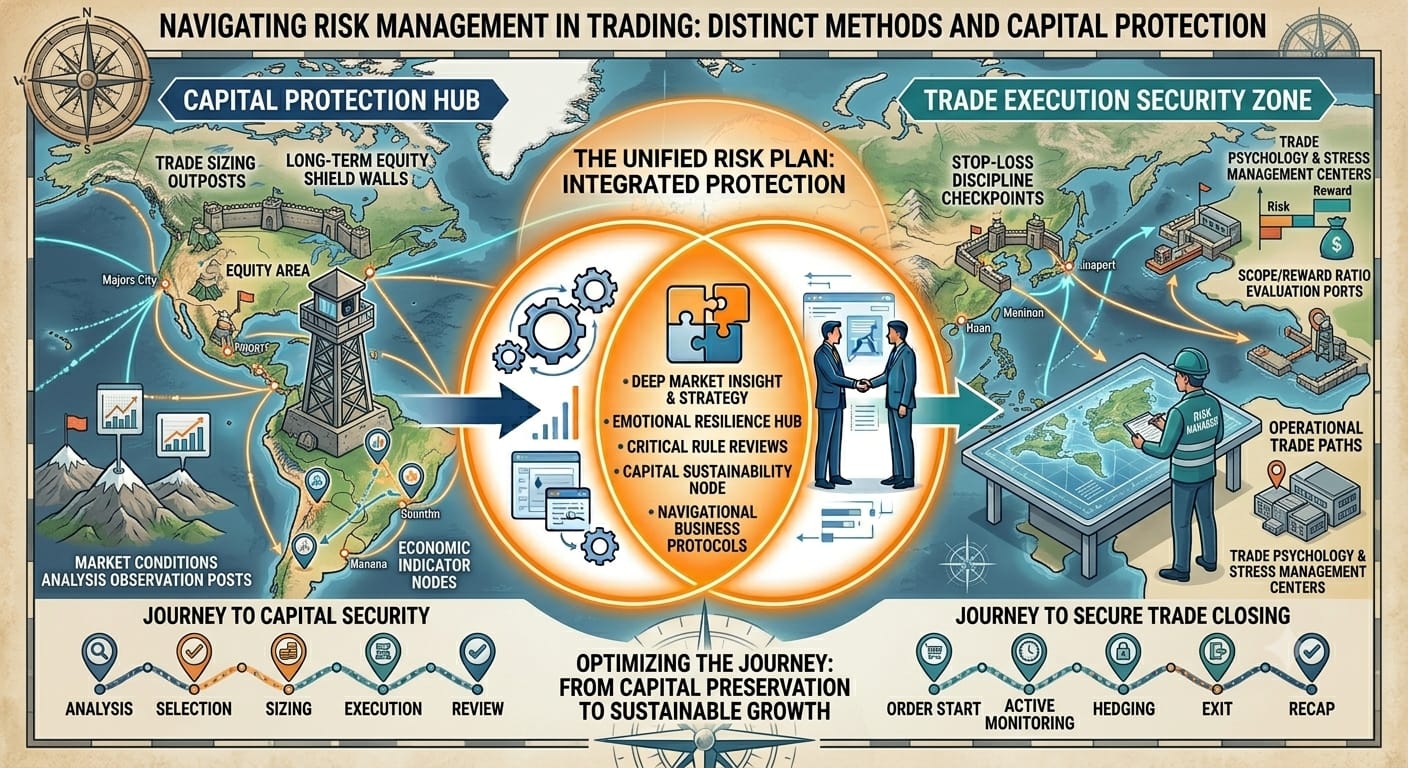
But professional traders ask a very different question: How much money can I afford to lose?
Welcome to the reality of risk management. Trading is not about predicting the future with 100% accuracy—that is impossible. Trading is about playing probabilities, managing the downside, and ensuring that when you are wrong (and you will be wrong often), you live to trade another day.
If you want to survive the markets, you must stop focusing on your profit targets and start obsessing over protecting your capital. Here is how you do it.
Do You Understand the Math of Ruin?
What happens when you take a big hit to your account? Most beginners assume that if you lose 20%, you just need to make 20% to get back to even.
But is that actually how the math works? No.
When your capital shrinks, you have less money working for you. This creates an asymmetric relationship between losses and the gains required to recover from them—a concept known as drawdown.
Consider this: If you have a $10,000 account and lose 50%, you are down to $5,000. To get back to your original $10,000, you don’t need a 50% gain. You need a 100% gain just to break even.
Here is the brutal reality of capital destruction:
| Account Loss (Drawdown) | Gain Required to Break Even |
| 10% | 11.1% |
| 20% | 25% |
| 30% | 42.8% |
| 40% | 66.6% |
| 50% | 100% |
| 75% | 300% |
Question to ask yourself: Are you taking trades that could wipe out 20% or 30% of your account in a single swing? If so, you are not trading; you are gambling. Once you cross the 20% drawdown threshold, the math works aggressively against you. The single most important rule in trading is avoiding catastrophic drawdowns.
How Much Should You Risk Per Trade? (The 1% Rule)
If massive drawdowns are the enemy, how do we prevent them? The answer lies in position sizing.
Many amateurs size their positions based on how confident they feel. If they “know” a stock is going up, they might put 50% of their capital into it. This is a recipe for disaster. Professional traders decouple their emotions from their trade size by using a strict mathematical boundary, often called the 1% Rule.
The 1% Rule states that you should never risk more than 1% of your total trading capital on a single trade.
To be clear: This does not mean you only buy $100 worth of stock in a $10,000 account. It means that the distance between your entry price and your exit point (where you admit you are wrong and sell) should result in a maximum loss of $100.
If you stick to the 1% Rule, you would have to lose 100 consecutive trades to wipe out your account. It gives you the ultimate luxury in trading: staying power.
Use this interactive tool to see exactly how many shares or contracts you should buy based on your account size and where you place your safety net.
Are You Trading Without a Safety Net?
You have calculated your position size, but how do you actually enforce it in the live market?
This is where the stop loss comes in. A stop loss is an automated order placed with your broker to sell your position if the price drops to a specific level. It removes human hesitation from the equation.
When a trade goes against an amateur, they often freeze. They ask themselves: What if it bounces back? Should I hold a little longer? By the time they finally accept the loss, a small paper cut has turned into a severed artery.
A hard stop loss makes the decision for you. It says: “If the price hits this line, my thesis is invalidated, and I am out.”
But a stop loss is only half of the equation. The other half is your Take Profit level. Together, these create your Risk/Reward Ratio (R/R).
What is a good Risk/Reward Ratio?
If you risk $100 (your stop loss) to make $100 (your target), your R/R is 1:1. To be profitable, you need to win more than 50% of the time.
But if you risk $100 to make $300, your R/R is 1:3. With a 1:3 ratio, you can be wrong on 70% of your trades and still be profitable overall.
- Risk $100 -> Lose (Down $100)
- Risk $100 -> Lose (Down $200)
- Risk $100 -> Lose (Down $300)
- Risk $100 -> Win (Make $300 — Account is now break-even)
Are you taking trades with a minimum 1:2 or 1:3 R/R? If you are constantly risking $500 to make a quick $100 profit, one bad trade will wipe out five good ones.
Can You Control Your Own Mind? (Psychological Risk)
We can discuss math, calculators, and ratios all day, but the final boss of risk management is the person staring back at you in the mirror.
Why do traders abandon their risk plans?
Usually, it comes down to two emotional extremes: FOMO (Fear of Missing Out) and Revenge Trading.
- FOMO: You see a stock rocketing upward. You didn’t do the research, you don’t have a planned entry, and your stop loss would have to be incredibly wide. But you buy anyway because you can’t stand watching others make money. You have just thrown risk management out the window.
- Revenge Trading: You take a completely normal, expected loss. But instead of accepting it as the cost of doing business, your ego gets bruised. You want to “make it back” immediately. You double your position size on a mediocre setup, completely abandoning the 1% Rule. This is how accounts die.
Question: What rules do you have in place to stop yourself from self-destructing?
Many professionals implement a “daily loss limit”—if they lose three trades in a row or drop 3% of their account in one day, they turn off their screens and walk away. The market will always be there tomorrow. Your capital might not be.
The Ultimate Question: Are You a Trader or a Gambler?
Trading is essentially the business of managing probabilities. If you prioritize capital preservation over capital appreciation, the profits will eventually take care of themselves.
Before you take your next trade, ask yourself:
- Do I know exactly where I am getting out if I am wrong?
- Am I risking less than 1% to 2% of my total capital?
- Does the potential reward justify the risk?
👉🏻Next post:-High-paying skills 2026👈🏻

Leave a Reply