

1.Lucid Stock Surges: Why Is Lucid Motors Stock Trending Today?
The automotive industry and financial markets are experiencing massive volatility as Lucid Group Inc. (NASDAQ: LCID) shares recently staged an aggressive, highly publicized bounce-back. The premium electric vehicle (EV) manufacturer, which was plagued by heavy panic selling that dragged the equity down to its absolute 52-week lows, suddenly skyrocketed in trading volume and price.

The Core Catalyst – The Rumor vs. The Reality
2.What is the primary reason behind the sudden surge and trending status of Lucid Motors (LCID) stock today?
The explosive surge in Lucid Motors’ stock is directly tied to an intense battle between market speculation and official corporate denial regarding the company’s solvency. The stock trended violently upward after Lucid’s executive leadership issued a vehement public refutation slamming widespread reports that the company was evaluating restructuring or a potential Chapter 11 bankruptcy filing.
The wild sequence began when an EV-focused media portal leaked an unverified report alleging that AlixPartners—a highly visible consulting and restructuring advisory firm hired by Lucid to streamline operational efficiency—had formally advised the board of directors to consider filing for Chapter 11 bankruptcy protection or executing a take-private transaction. Because the EV sector has recently seen high-profile failures (such as Fisker and Lordstown Motors), the word “bankruptcy” triggered immediate, systemic panic among retail and institutional algorithms alike.
The subsequent surge was fueled by a dual mechanism:
- The Executive Counter-Attack: Management forcefully stepped forward to label the reports “completely false,” clarifying that their engagement with AlixPartners was strictly focused on cost-optimization and manufacturing throughput, not restructuring.
- The Short Squeeze Mechanics: Lucid is a heavily shorted stock. When the definitive denial was broadcasted, short-sellers who had rushed to short the stock on the bankruptcy rumor were caught in a legal and financial bottleneck. To cap their risks, they had to aggressively buy back shares, causing an immediate, compounding upward price spiral known as a short squeeze.
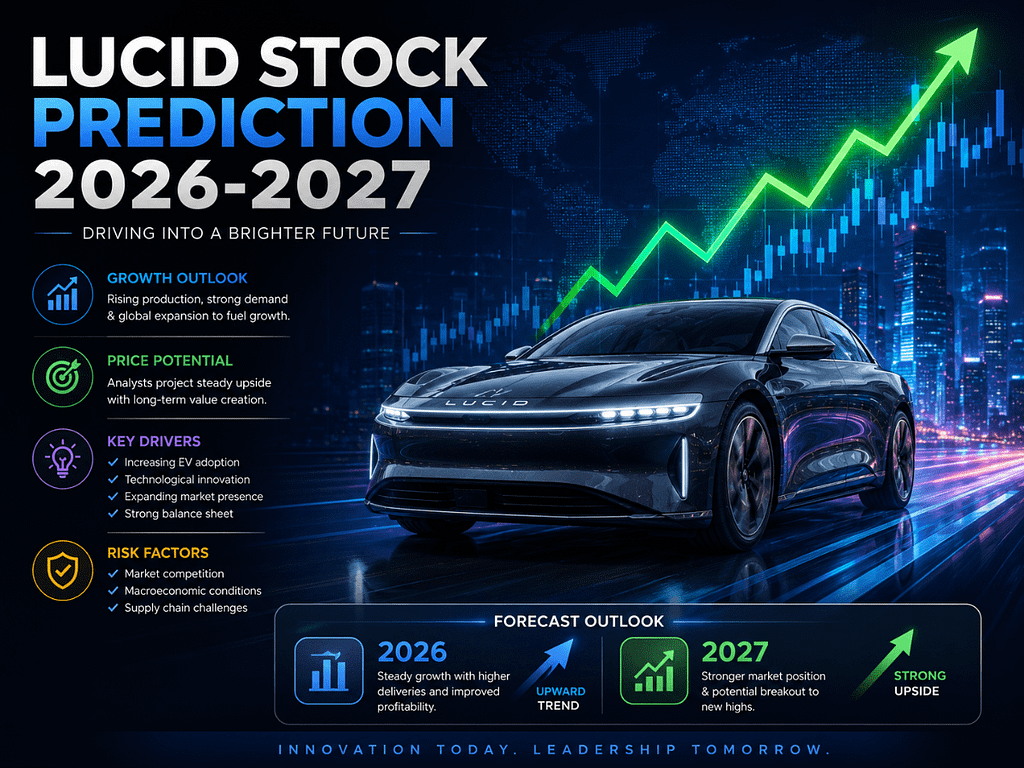
3.Can you outline the exact trading chronology of this multi-day drawdown and subsequent recovery?
The movement of LCID stock over this volatile weekly cycle followed a highly dramatic, textbook market pattern:
[Phase 1: The Rumor Leak] ──> Media alleges AlixPartners advised Chapter 11 filing.
[Phase 2: The Flash Crash] ──> Stock plummets over 46-50% intraday, triggering multiple circuit breakers.
[Phase 3: All-Time Low reached] ──> LCID hits an absolute bottom of $2.37 per share.
[Phase 4: The Denial Surge] ──> Management refutes rumors; stock pops 29% in a single session.
[Phase 5: Stabilization] ──> Equity settles near the $6.46 range, testing its 20-day moving average.
- The Inception: Prior to the leak, the stock was trading quietly around the $5.54 mark. Midday on Tuesday, the unverified restructuring report hit the tape.
- The Flash Crash: Shares plunged up to 46% to 50% within hours. The downward momentum was so severe that the Nasdaq exchange had to implement multiple Volatility Trading Stops (circuit breakers) to restore order. The panic eventually drove the equity down to an all-time intraday low of $2.37. Trading volume exploded to over 155 million shares—more than five times its three-month average.
- The Rebound: Following a series of stern corporate announcements and a high-profile public post affirming that the company was absolutely not considering a take-private or bankruptcy proceeding, the narrative flipped. The stock erased the catastrophic losses via a single-day 29% pop, eventually stabilizing and consolidating around the $6.46 mark.
Structural Financial & Balance Sheet Deep-Dive
4.What concrete arguments did Lucid’s management provide to prove they are far from bankruptcy?
To successfully neutralize the bankruptcy narrative, Lucid’s management pointed directly to their calculated liquidity runway, arguing that their capital reserves set them far apart from typical distressed EV startups.
Management emphasized that the company closed its most recent financial periods with a highly robust safety net of approximately $3.2 billion in total liquidity. Furthermore, this capital position was strongly reinforced by a massive $1.05 billion capital raise, which featured structural investments from major partners, including an affiliate of Saudi Arabia’s Public Investment Fund (PIF).
According to the executive team, this cash cushion gives Lucid a clear operational runway extending deep into 2027. In the world of automotive manufacturing, navigating what is known as “production hell”—the capital-intensive phase of scaling factory outputs before achieving unit-level profitability—requires billions. Lucid argues that its heavy capital expenditure is an intentional investment in scaling its new product line, rather than a sign of systemic insolvency.
5.When stripping away public relations, what do the hard fundamental metrics reveal about Lucid’s financial health?
While the short-term relief rally is impressive, a cold examination of Lucid’s core financial indicators reveals a deeply leveraged, high-risk operational profile. A breakdown of the company’s primary fundamental metrics illustrates why the market remains highly reactive:
| Financial Metric | Verified Value / Status | Professional Implications & Interpretations |
| Financial Strength Score | 2 / 10 | Indicates an extreme imbalance between cash generation and debt obligations; highly reliant on external capital injections. |
| Net Profit Margin | -239.81% | Lucid is losing significantly more than it earns on every vehicle sold; production costs heavily outweigh current retail pricing power. |
| Price-to-Sales (P/S) Ratio | 1.04 | Depressed relative to historical tech valuations, signaling that the market has priced in a substantial risk premium. |
| Annualized Cash Burn | ~$2.5B to $2.8B Net Loss | The speed at which the company spends its cash reserves means its $3.2B runway will dry up unless production reaches scale swiftly. |
| Quarterly Net Income | -$1.03 Billion (Q1 ’26) | Demonstrates persistent, deep losses that continue to stress the capital structure quarter-over-quarter. |
The fundamental reality is that Lucid possesses an elite engineering architecture but a highly fragile financial architecture. The market’s anxiety is rooted in fact: without continuous, multi-billion-dollar backstops from outside entities, the current cash burn rate would lead to severe capital distress within 18 to 24 months.
The Saudi Sovereign Fund (PIF) Backstop
6.What role does Saudi Arabia’s Public Investment Fund (PIF) play in Lucid’s survival strategy?
The Public Investment Fund (PIF) of Saudi Arabia is the absolute cornerstone of the bullish investment thesis for Lucid Motors. PIF is not merely a passive institutional investor; it is the majority stakeholder, controlling over 60% of Lucid’s total outstanding common equity.
Since 2018, the Saudi sovereign wealth fund has systematically injected more than $9 billion into Lucid through multiple private placements, credit facilities, and structured equity rounds.
┌───────────────────────────────────────────── ────── ────┐
│ SAUDI ARABIA PUBLIC INVESTMENT FUND (PIF) │
│ (Majority Owner: ~60%+) │
└────────────────────────────────────────────────────────┘
┌────────────────────┴────────────────────┐
▼ ▼
[Strategic Capital Line] [Vision 2030 Mandate]
• Over $9B injected since 2018 • AMP-2 Factory in King Abdullah City
• $1.05B latest capital push • 100,000 vehicle government contract
For Saudi Arabia, Lucid represents a vital macroeconomic piece of their “Vision 2030” initiative, which seeks to transition the Kingdom away from absolute oil reliance toward advanced global technology, clean energy, and domestic manufacturing manufacturing hubs.
Because of this geopolitical and macroeconomic alignment, Wall Street analysts widely view the PIF as an infinite capital cushion. If Lucid were to approach actual insolvency, the PIF is highly incentivized to execute a full “Take-Private” transaction—buying out all remaining retail shares and absorbing the debt—rather than allowing the brand to collapse in a public bankruptcy court. This unique sovereign backstop provides a floor for the stock that independent EV rivals simply do not have.
7.Is Lucid shifting its primary geographic and commercial focus away from the United States to the Middle East?
Yes, a distinct, deliberate geographic pivot is underway. The North American luxury EV market has slowed down significantly due to high interest rates, macroeconomic caution, and intense luxury competition from legacy giants like Porsche, Mercedes-Benz, and Tesla. Lucid has struggled to generate high-volume demand in the US for its high-end Air sedan models.
Consequently, the company is leaning heavily into its Middle Eastern ecosystem:
- Guaranteed Government Offtake: The Saudi Arabian government has committed to purchasing up to 100,000 Lucid vehicles over a multi-year period, providing a guaranteed demand pipeline completely insulated from US consumer sentiment.
- Domestic Production Scaling: Lucid’s AMP-2 manufacturing facility located in King Abdullah Economic City (KAEC), Saudi Arabia, is actively scaling up production. Initially assembling semi-knocked-down (SKD) kits imported from Arizona, the plant is transitioning into full-scale complete vehicle manufacturing.
This pivot allows Lucid to use the Middle East as a protected, highly subsidized incubator while its domestic US operations undergo structural adjustments to lower manufacturing costs.
Operational Overhaul, Product Scaling, & Tech Integration
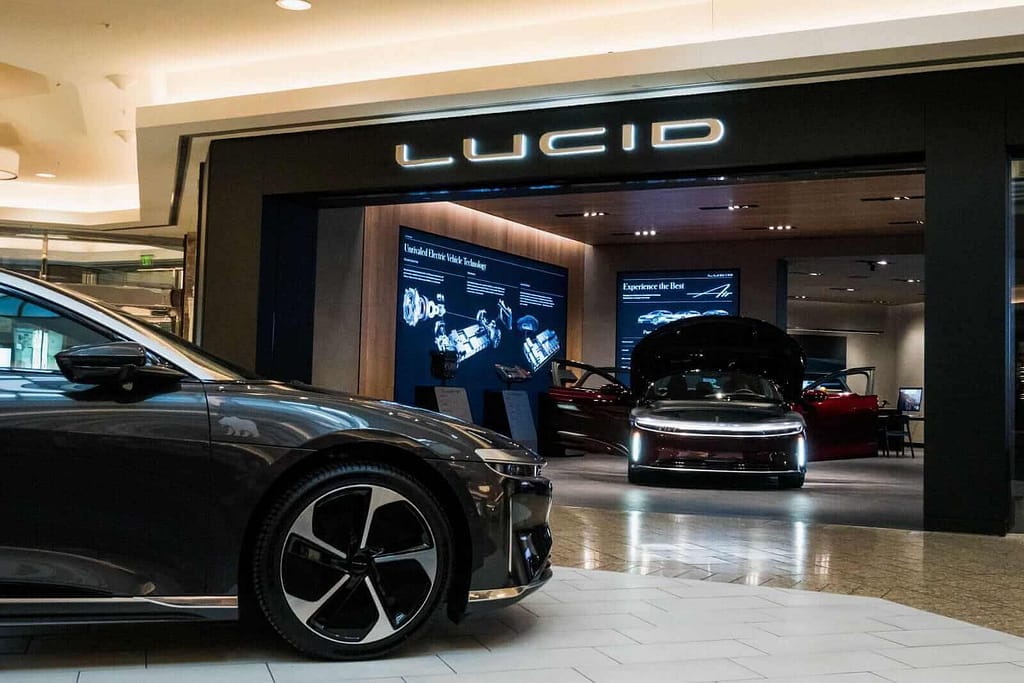
8.Alongside the financial news, what major corporate leadership changes and product expansions are driving the stock’s trend?
The relief rally following the bankruptcy denial was heavily amplified because it coincided with a sweeping leadership overhaul instituted by the board of directors. The market viewed this sudden executive restructuring as a proactive, aggressive move to fix the company’s chronic manufacturing bottlenecks and lagging sales execution.
On the product side, the entire future valuation of the company is resting on the scaling of the Lucid Gravity SUV. While the Lucid Air sedan proved the company’s elite range capabilities, the global luxury market is heavily biased toward SUVs. The Gravity model targets a vastly larger total addressable market (TAM).
To support this product rollout, Lucid has deployed advanced over-the-air (OTA) software updates designed to close the software gap with competitors like Tesla. Recent software integrations include:
- DreamDrive Pro 2 Evolution: Enhanced hands-free highway driving assistance, localized mapping adjustments, and improved multi-camera sensor fusion to enhance safety ratings.
- Native Google Maps Places API Integration: Streamlining point-of-interest discovery and delivering real-time predictive analytics on charging station availability and destination battery pre-conditioning.
- Optimized Thermal Pre-conditioning: Allowing the vehicle’s battery pack to automatically adjust its internal chemical temperature when navigating toward a fast charger, maximizing peak intake wattage and slashing charging times.
Institutional Accumulation and Uber’s
9.What does regulatory SEC data show regarding institutional backing, and how does Uber fit into the Lucid ecosystem?
A hidden catalyst supporting the stock’s recovery is the steady, quiet accumulation of shares by large institutional entities and corporate heavyweights. While retail sentiment was highly fragmented and driven by panic, professional funds were building structural blocks.
Most notably, filings show a highly strategic connection with ride-hailing giant Uber Technologies (UBER). Uber holds an approximate 11.5% equity ownership stake in Lucid Group, holding millions of shares. This massive position has triggered intense industry speculation regarding a long-term commercial partnership centered around Autonomous Robotaxis.
Uber’s global ride-hailing platform requires ultra-efficient, highly durable, long-range premium electric platforms to meet its impending zero-emission corporate mandates. Lucid’s powertrain technology boasts the highest electrical efficiency in the industry, making it an ideal hardware foundation for future premium autonomous fleets.
Furthermore, global banking institutions like BNP Paribas have recently doubled their baseline positions, signaling to the broader market that institutional smart money considers the asset structurally undervalued when trading near its cyclical lows.
Future Valuation & Professional Market Consensus
What is the current consensus among Wall Street analysts regarding LCID stock?
Wall Street analysts are sharply divided on Lucid Group, creating a wide dispersion in price targets and ratings. The consensus remains tightly bound to a “Hold” profile, with analysts taking a strict look-and-see approach toward the new leadership team.
The macro-breakdown of the 21 analysts actively covering the equity highlights this caution:
[Wall Street Analyst Structural Breakdown]
├── BUY : 14.3% ── Aggressive tech bulls focusing on powertrain efficiency.
├── HOLD : 64.3% ── Sizable majority waiting for Gravity SUV delivery scaling.
└── SELL : 21.4% ── Bear case focused on persistent cash burn and net debt.
- The Bear Position (e.g., Morgan Stanley): Maintains an Underweight/Sell rating with a strict $5.00 price target. Their core thesis rests on the continuous, structural need for capital raises, which dilutes existing shareholders and limits near-term upside.
- The Neutral Position (e.g., Cantor Fitzgerald, RBC Capital): Maintains a Hold rating with price targets scaled between $7.00 and $8.00. They acknowledge that the bankruptcy fears were heavily overblown, but they refuse to upgrade the stock to a “Buy” until clear quarterly delivery metrics prove the Gravity SUV can generate meaningful revenue.
- The Aggressive Bull Position (e.g., Citi): Holds an idiosyncratic Buy rating with targets as high as $14.00, betting entirely on the monetization of Lucid’s proprietary powertrain licensing deals with global OEMs like Aston Martin.
Summing it all up—what is the comprehensive market data summary and final investor takeaway
To evaluate an entry or exit position following this massive surge, investors must cross-reference the core technical data points:
📊 Lucid Group (NASDAQ: LCID) Comprehensive Market Blueprint
| Capital Metric | Current Value (USD) | Operational Meaning & Market Impact |
| Current Market Price | $6.46 | Reflects full recovery from the rumor-induced panic floor. |
| 52-Week Trading Range | $2.37 – $33.70 | Highlights the immense historical volatility and beta of the stock. |
| Total Market Capitalization | $2.52 Billion | Places Lucid firmly in the mid-cap growth spectrum. |
| Mean Wall Street Target | $8.30 | Represents an implied upside of roughly 28% to 40% if execution stabilizes. |
| Q2 ’26 Deliveries Volume | 3,953 Vehicles | The baseline volume metric that the company must aggressively scale. |
Final Strategic Verdict:
Lucid Motors remains an archetypal High-Risk, High-Reward speculative growth play. The sudden surge proved that the stock possesses massive short-covering elasticity and a highly defensive safety floor provided by the Saudi PIF.
If you are a conservative value investor, the deep operational net losses (-$1.03B per quarter) mean you should avoid the stock. However, if you are an aggressive macro-trader looking for a company with world-class EV technology, clear sovereign backing, a fresh management turnaround strategy, and a major corporate footprint via Uber, purchasing shares near consolidated technical support levels could yield significant long-term growth as the Gravity SUV enters full commercial scale.

Leave a Reply