

The Great Rewiring: How the Internet Reshaped the Human Experience
The internet was never just a tool; it was a terraforming event for the human psyche. In less than three decades, it has shifted from a niche playground for academics to the very oxygen of modern existence. We don’t “go” online anymore; we live there. This digital migration has fundamentally altered how we think, how we relate to one another, and how we perceive our place in the universe.
To understand how the internet has changed us, we must look at the four pillars of the human experience: Cognition, Connection, Consumption, and Character.
The Death of the Deep Dive: Cognition in the Age of Scarcity
Before the digital age, information was scarce and precious. If you wanted to know the nuances of the French Revolution, you went to a library, pulled a book, and committed hours to focused, linear reading.
Today, we suffer from “The Shallows.” Our brains have adapted to the hyperlinked nature of the web. We have become incredibly efficient at skimming, scanning, and multitasking, but our capacity for deep, sustained attention is fracturing.
Externalized Memory: We no longer feel the need to remember facts when we have The Great External Brain” (Google) in our pockets. This is the Google Effect: our brains prioritize remembering where to find information rather than the information itself.
The Neuroplasticity of the Scroll: The “infinite scroll” mechanics of social media exploit our dopamine loops. We are becoming biologically rewired to seek short-term hits of novelty, making the slow burn of a 400-page novel feel like a chore.
The Paradox of Connection
The internet promised a global village, and it delivered—but villages can be claustrophobic. We are more “connected” than ever, yet loneliness statistics are skyrocketing.
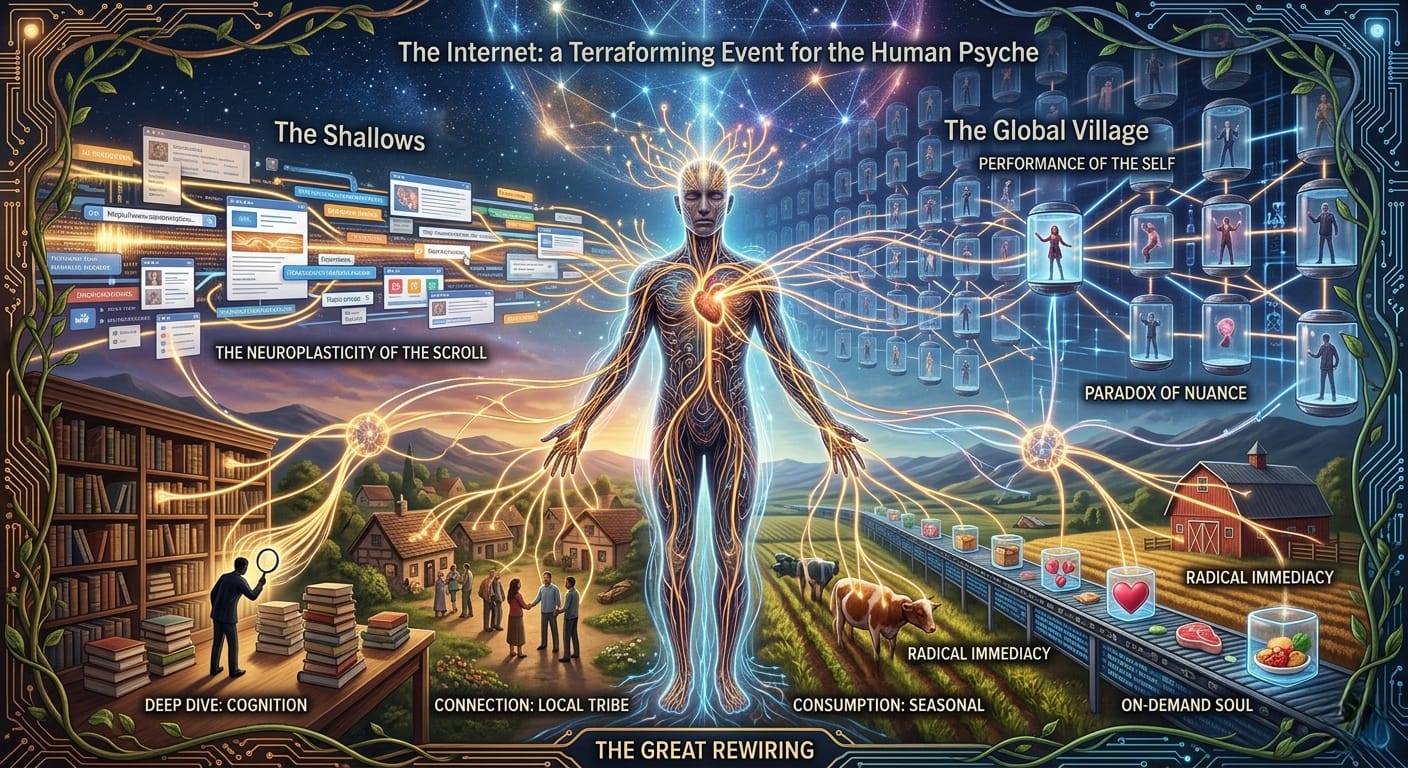
The Performance of the Self
Social media has turned everyday life into a public relations campaign. We no longer just experience a sunset; we curate it for an audience. This constant performative state creates a “compare and despair” cycle. When we view the highlight reels of others through a screen, our own “behind-the-scenes” reality feels inadequate.
The Erosion of Nuance
In the digital space, complexity goes to die. Because online interaction lacks the physical cues of human empathy—eye contact, tone of voice, touch—we tend to dehumanize those we disagree with. This has led to the rise of outage culture and echo chambers. We don’t seek truth; we seek “likes” from our tribe. We have traded the messy, difficult work of physical community for the easy, frictionless validation of digital circles.
Consumption and the “On-Demand” Soul
The internet has effectively killed the concept of waiting. We live in an era of radical immediacy. Whether it’s a romantic partner (Tinder), a meal (UberEats), or a niche product (Amazon), the gap between “I want” and “I have” has shrunk to almost zero.
The Death of Boredom: Boredom used to be the seedbed of creativity. Now, any moment of quiet is immediately filled by a screen. We have lost the ability to sit with our own thoughts, leading to a decline in internal reflection.
The Commodity of Attention: In the physical world, the currency is money. In the digital world, the currency is attention. We are no longer the customers of the internet; we are the products. Our habits, fears, and desires are harvested to keep us clicking, changing us from active citizens into passive consumers of content.
The Fluidity of Identity
Historically, your identity was largely determined by your geography and your family. The internet shattered those walls. It allowed people—especially those in marginalized or niche communities—to find their people.
On the Internet, nobody knows you’re a dog.” — Peter Steiner (1993)
This famous cartoon captured the early optimism of digital identity: the idea that we could be whoever we wanted to be. However, this has evolved into a strange duality. We have our Physical Self and our Digital Avatar. Often, these two are in conflict. We might be bold and aggressive online while remaining shy and withdrawn in person. This “Online Disinhibition Effect” has changed our moral compass, often allowing us to say things to strangers that we would never utter to a neighbor’s face.
The democratization of Power (and Chaos)
The internet has leveled the playing field. A teenager in a basement can now start a movement, collapse a stock, or educate millions. This is the internet’s greatest gift: the democratization of agency.
However, this power comes with a dark twin: the death of expertise. When everyone has a megaphone, the loudest voice often wins over the most informed one. We have moved from a world of “gatekeepers” (editors, professors, librarians) to a world of “algorithms.” Algorithms don’t care about truth; they care about engagement. This has fundamentally changed how we perceive reality, leading to a fragmented world where two people can live in the same city but inhabit two completely different factual universes.
The New Human
Are we better off? The answer isn’t a simple binary.
The internet has extended our reach to the stars while sometimes making us forget how to walk on the ground. We have gained the world but are struggling not to lose our focus, our patience, and our empathy in the process.
The challenge for the next generation is not to figure out how to “unplug”—that ship has sailed. The challenge is to remain human in a system designed to treat us as data points. We must learn to reclaim our attention, value our boredom, and remember that while the internet is a great place to visit, it’s a dangerous place to live.


Leave a Reply