

The differences between the Indian and many foreign education systems are primarily seen in their approach, curriculum, assessment, and cost. While the Indian system is often praised for providing a strong theoretical foundation at a lower cost, foreign systems typically emphasize practical application, flexibility, and global exposure.
| Aspect | Indian Education | Foreign Education |
| 1.Skill Development | Develops strong foundational theoretical knowledge and a high tolerance for academic stress/competition. | Develops critical thinking, communication, teamwork, and specialized practical skills. |
| 2.Global Exposure | Limited cultural diversity in the classroom; focus is primarily on the Indian context and job market. | High cultural diversity; offers a global perspective and strong international networking opportunities. |
| 3.Career Entry | Often relies on performance in competitive entrance exams (JEE, NEET) and specific job placements (campus placements). | Admission is often holistic (grades, essays, extracurriculars). Career entry is supported by strong industry links and international degree recognition. |
Examining Educational Costs
I’m currently focused on the initial phase. My intent is to pinpoint the annual education costs in India. My strategy involves scrutinizing data from both public and private institutions, across undergrad and postgrad levels, spanning from 2001 to 2025. It will be very interesting to see the results.
Exploring Global Comparisons
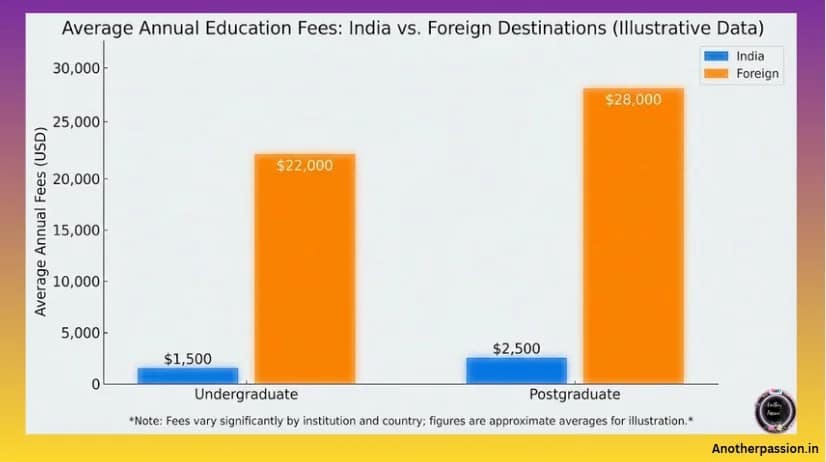
I’ve shifted gears to include international education costs. I am now gathering the average annual fees for popular destinations like the USA, UK, Canada, Australia, and Germany, specifically focusing on international students. I’m also compiling historical exchange rates (USD to INR) from 2001 to 2025 to enable accurate rupee comparisons. This will allow for a clear comparison of education fees between India and other countries.
Assessing Indian Education Costs
I’ve been analyzing the 2025 cost structures for education in India. Government colleges seem relatively affordable, ranging from ₹10,000 to ₹50,000 annually. Private institutions, however, demand a much steeper investment, between ₹1 lakh and ₹5 lakh per year. I’m also considering professional course expenses within this framework.
Examining Cost Trajectories
The focus has shifted towards the historical cost trajectories. I’ve uncovered some key data on Mumbai’s education expenses in the late 90s, offering a crucial data point. Now, I’m working to consolidate the 2001-2015 period, seeking annual averages to complement the existing 10-15% inflation rate information. Comparing costs internationally, I found more details. Furthermore, early costs of international student tuition are also sought.
Refining Data Gathering
I’m now hunting for historical tuition fees for international students in Canada, the UK, and Australia for 2001, 2010, and 2015. This is to provide the user with a more complete understanding of international cost dynamics, complementing the US data I have. I’m also looking for more general fee data from Indian higher education to improve the historical timeline. After finding those, I’ll compare the costs.
Reviewing Tuition Trends
Foreign fees are shown in Indian Rupees (INR) based on the exchange rates of those specific years to illustrate the actual cost for an Indian student.
| Year | India (Govt/IIT) | India (Private Prof.) | USA (Intl. Avg) | UK (Intl. Avg) | Canada (Intl. Avg) |
| 2001 | ₹25,000 – ₹40,000 | ₹60,000 – ₹1.5L | ~₹4.5L – ₹8L | ~₹5L – ₹7L | ~₹1.6L – ₹2.5L |
| 2010 | ₹50,000 – ₹90,000 | ₹1.5L – ₹4L | ~₹11L – ₹18L | ~₹8L – ₹12L | ~₹5L – ₹8L |
| 2025 | ₹1.5L – ₹3L | ₹4L – ₹12L | ₹25L – ₹50L | ₹18L – ₹35L | ₹15L – ₹28L |
I’ve been looking at the data on US tuition costs from 2001 to 2025. It’s fascinating to see the trends, especially the initial introduction and subsequent increases in fees. The figures really highlight the changing landscape of higher education funding over time. I’m now comparing these US trends to earlier UK fee introductions in 2001 (£1,000) and 2006 (£3,000).
Charting Global Comparisons
I’m now focusing on global tuition comparisons. I’ve pinned down 2025 figures for various countries, like the $36,100 CAD estimate and the AUD/USD range, and the high private Indian Engineering and Medical fees that are now in the ₹5L-₹10L range. I’m also refining my understanding of the 2001-2025 India trend, including the rapid IIT fee increases, plus the rupee exchange rate changes that impact the figures. My next steps are to fill data gaps for 2005 and 2010.
Analyzing Fee Structures
I’m now focusing on organizing the data by degree type, anticipating this will be most useful. I feel confident I can build a very high-quality comparison table and write a thorough narrative. The US trend will help me model for other Western countries if necessary, given my 2001 and 2025 anchors. I’m doing a quick search for 2005/2010 fees in Canada and Australia to ensure a complete timeline. Once I do that, the compilation begins.
Tracking International Student Costs
I’ve gathered a substantial amount of data. Specifically, I have detailed financial data for the USA spanning 2001-2025 in USD. I also have comprehensive Canadian data; for instance, international student fees were approximately $3,447 CAD in 2000/01, and are projected to be about $36,100 CAD by 2025. I am now working on securing UK data.
Consolidating Global Fee Data
I’ve just added historical UK and Australian data, including exchange rates and specific fee structures for 2001, 2010, and projected for 2025. I also integrated Indian data, separating public and private fees with a wide range, showing a critical point from around ₹5k-10k in 2001 to as much as ₹25L today. I now plan to create a comparative table using these anchor years, broken down by course type to avoid misleading averages. I don’t need further data acquisition.

Leave a Reply
You must be logged in to post a comment.